

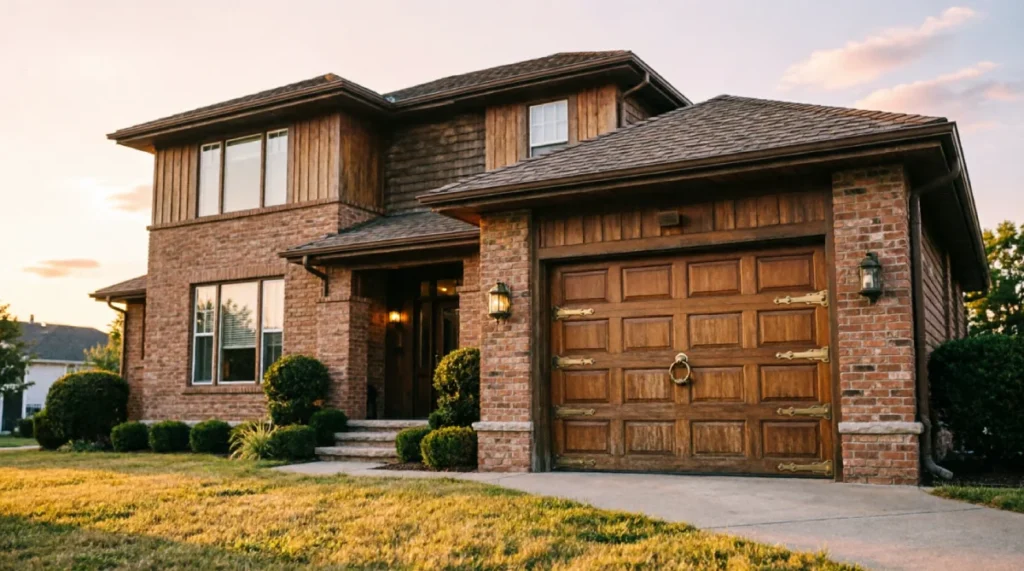
Many homeowners choose a garage door incorrectly. They flip through catalogs and choose something that looks good in isolation. The door comes, it goes, and suddenly, it’s the illusion that there are two different buildings in one.
Before you look at any product, you have to read the exterior of your home as a system and determine the role that the garage door needs to perform.
This means getting on the street and asking a few questions:
- Is the garage flush with the façade or recessed back?
- Does the home have strong horizontal lines or strong vertical lines?
- Are the exterior materials warm and textural or cold and textural?
Those answers will determine if your garage door should be a focal point that stakes a claim or if it’s a background element that ties the composition together without competing with the rest.
Match the Architectural Era First
Each major housing style has a look that goes with it. Leave aesthetics aside; we’re not talking about raw beauty, we’re talking about logic. Your garage door needs to work with that logic rather than against it.
Heritage homes, think Victorian, Edwardian, Federation, are ‘real’ houses with generous lots, high ceilings, and lots of ornamentation. In crude terms, they’re supposed to look grand and fancy. Whereas carriage-house style garage doors on more modern homes can look affected, they make perfect sense here. You want raised panels, decorative strap hinges, maybe even some windows up top, and, most importantly, period-accurate hardware. Your door doesn’t have to be made of timber these days, but it has to convincingly look the part.
Mid-century modern homes are pretty much the exact opposite. They’re all about clean horizontal planes, flat planes with no panels, asymmetrical windows, and a defiant lack of ornamentation. A door that has heavy decorative hardware, or looks to be patched together out of oblong panels in a jigsaw-puzzle fashion, is an instant, copper-bottomed mismatch. Flush or lightly ribbed aluminum panels in a matte finish are probably the correct answer 9 out of 10 times you ask the question.
Craftsman homes sit somewhere in the middle: they were always designed to show their natural materials, meaning that anything timber-look, featuring visible grain, is rewarded. Also favoured are warm brown and olive tones, and wrought-iron hardware pieces that, because they look like they might be involved in the operation of a machine, read as functional rather than decorative.
For what it’s worth, anywhere that the Hamptons style finds its way tends to go even lighter than the Craftsman requirement: paneled or shaker-style pieces in white, soft grey, or pale blue, often with window inserts to mirror the home’s main glazing.
Color Strategy: Connect to the Trim, Not the Wall
This is where a lot of well-intentioned decisions go sideways. Matching the garage door to the primary wall color, brick, render, or siding, tends to make the garage look like it’s trying to disappear, or worse, it creates a flat, undifferentiated block of color across the entire front elevation.
The stronger approach is to connect the door to the secondary palette. Match it to the trim, the fascia, the gutters, or the roofline. This integrates the door into the exterior composition without letting it dominate.
A charcoal roof with white trim? A white or off-white garage door with charcoal hardware will tie the whole thing together. Warm sandstone brick with timber window frames? A composite door in a matching timber-look finish pulls those elements into alignment.
When you’re coordinating exterior elements across multiple surfaces, such as garage doors, window frames, shutters, and trims, it helps to work with specialists. Companies like AllStyle Garage Doors & Window Shutters are set up to match these elements across an entire façade rather than treating each component in isolation, which is where most DIY color decisions fall apart.
Windows Create or Break Exterior Symmetry
The design of windows on a garage door should be consistent with the design of windows on the rest of the house. Mimic the normal panes, shapes, sizes, and patterns. For example, if your house has small square windows, add small square windows to your garage door. This rule applies to both the number of windows and their layout.
Placement matters just as much as style. Windows positioned too high or too low on a garage door panel can look awkward even if the shape is right, so take note of where your home’s existing windows sit relative to their frames and try to echo that visual logic. Centred, evenly spaced inserts tend to read as intentional; asymmetric clusters rarely do.
Glass type is another variable worth thinking through. Frosted or obscured glass adds privacy while still letting light into the garage, whereas clear panes work well when the interior is tidy or deliberately styled. If your home already features decorative glazing, leaded lines, subtle tinting, and divided lites, carrying that detail across to the garage door elevates the whole façade rather than leaving it looking like an afterthought.
It’s also worth considering how windows interact with the garage door material itself. On timber doors, framed inserts tend to look more considered than flush-mounted panes. On steel or aluminium, clean geometric shapes usually suit the material better than ornate designs. Getting this pairing right means the windows don’t just match the house; they belong to the door as well.
Hardware is the Finishing Detail That Authenticates the Whole Thing
A sectional garage door, with the right hardware, doesn’t look like a sectional garage door. It looks intentional. Wrought iron strap hinges and ring pulls on a timber-look carriage door make the design read as authentic, even when the mechanism behind it is entirely modern. Minimalist flush pulls in brushed nickel or matte black on a contemporary door do the same thing; they signal that someone thought this through. Powder-coated steel gives you the durability to carry hardware finishes without rust or fading.
The material does the functional work; the hardware does the design work. Garage door replacement consistently delivers a strong ROI at resale. Remodeling Magazine’s Cost vs. Value Report puts the average cost recoup above 100%, but that return is tied to execution. A door that fits the home builds value. One that doesn’t can actively work against it. Get the architectural read right first, and the product choice becomes much more straightforward.
