

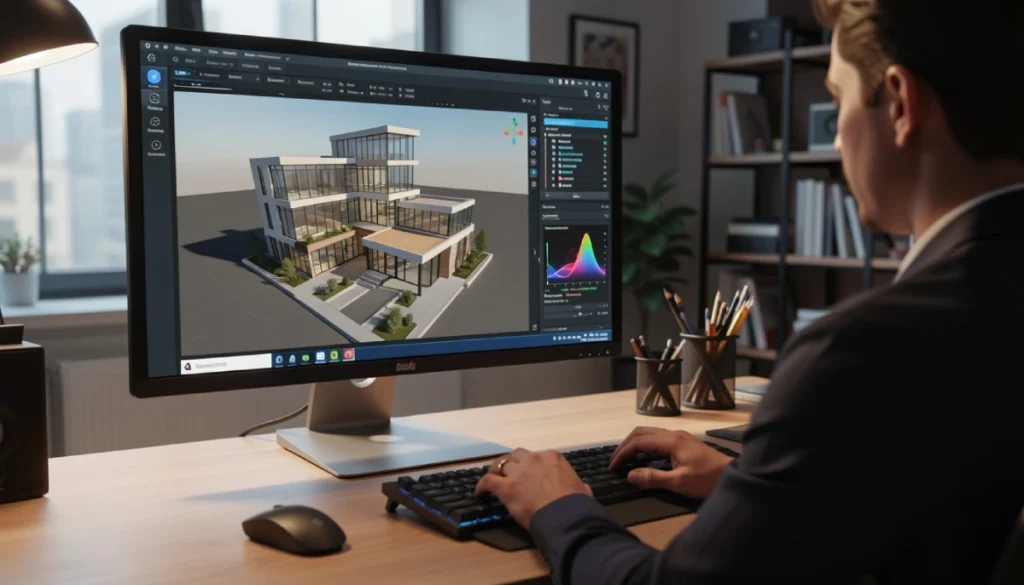
The field of three-dimensional (3D) rendering is being transformed by Artificial Intelligence today. It is becoming quicker, more precise, and, most of all, more realistic as time goes by. By using AI in 3D rendering, businesses and creators are able to create incredible visuals with increased focus.
AI rendering enhances processes by forming more effective and higher-quality results as it studies and learns from a lot of data. Now, creating the most complex environments, lifelike shadows, or textures can be done with the assistance of AI.
In a few years, that is in 2026, there will still be more advances in the 3D rendering integration, and its AI features will still be developed, which will make the tight workflows more organized as well as improve creativity. This technology will set a new standard in the industry, from choreographed activities to minute detail refinement.
Key Benefits of AI-Driven 3D Rendering
The pros are numerous; let’s take a look at the key ones.
Much Better Accuracy and Realism
AI in architecture proves that it can capture every element that is in 3D space and make it look real. Just like today, realistic textures, accurate lighting, and movements are easy to produce and make any design look realistic.
Resources (and Time!) Efficiency
Classic rendering is known to be time-consuming and could also be processor-demanding. But with AI-driven rendering, there will be a time reduction as the process can generate patterns and optimize resource use in order to finish the project quicker.
Advanced Customization
AI 3D modeling is evolving with inclusiveness, thanks to AI, empowering designers to fine-tune just about any element from materials to environments and achieving unique outcomes that fit the demand of the project perfectly.
AI Innovations Expected in 2026
What about 2026 rendering trends? With AI revolutionizing the way we present our designs, 2026 has a lot to offer in terms of AI 3D rendering technology capabilities:
- Smarter Rendering Tools. New AI-based tools will emphasize predictive analytics, and design change should be automatic.
- Real-Time Rendering. More efficient algorithms will increase the scope of real-time rendering even for complex models, thus reducing the time it takes to go through several cycles.
- Broader Applications. AI will extend to new areas of focus, giving room for novel applications within the spatial computing, gaming, and augmented reality domains.
With these innovations, the future of 3D rendering promises to be more active and effective while offering greater opportunities for the creators.
AI-Driven Rendering in Different Industries
AI is changing all industries: no need to ignore it.
Architecture
With AI, it becomes possible to build detailed, realistic models of buildings that assist both the builders and the customers in envisaging the outcome before any construction work. Such a render can be made while taking into account the surrounding area, which is also a plus.
Real Estate
AI-powered 3D renderings provide real estate developers with the means to market properties in a more appealing manner, thus resulting in faster sales by attracting more clients.
Product Design
As for product design, AI 3D modeling is used in the prototyping stage to generate accurate and in-depth images of ideas, which reduces the time taken to be operational.
Conclusion
AI-based rendering is creating the waves of the future of 3D rendering technology with advancements that will improve quality, efficiency, and creativity. The effects can be seen in many sectors in the way businesses and the audience interact with them.
Looking to improve your projects in new ways? Do not hesitate to order our AI-rendering services so your sales increase thanks to your visuals. Follow the link https://www.genense.com/.
