

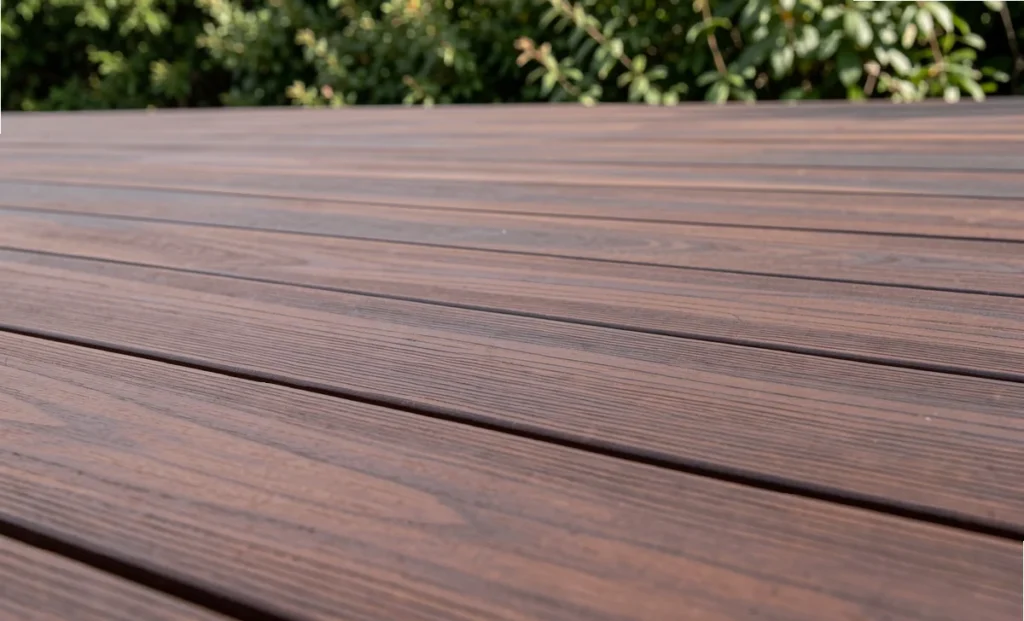
IPE wood — also known as Brazilian Walnut — is one of the most sought-after hardwoods for outdoor decking in North America. Prized by contractors and homeowners alike for its extraordinary density, natural durability, and rich brown color, IPE has earned its reputation as the premier choice for high-performance outdoor applications. Whether you’re building a residential deck, a waterfront dock, or a commercial boardwalk, understanding IPE’s properties, available dimensions, and sourcing options is essential before you invest.
What Makes IPE Wood Exceptional
IPE (Tabebuia spp.) is a tropical hardwood native to South America, primarily harvested from Brazil, Bolivia, and Peru. It ranks among the hardest commercially available lumber species, with a Janka hardness rating of 3,684 lbf — more than three times harder than white oak. This density translates directly into performance: IPE decking is naturally resistant to rot, decay, insects, mold, and mildew without any chemical treatment required.
One of IPE’s most compelling features is its lifespan. Properly maintained IPE decking can last 25 to 75 years in outdoor environments, far outlasting pressure-treated lumber (10–15 years) and most composite decking products. Its natural oils provide built-in protection, making it a low-maintenance option for homeowners who want a premium appearance without constant upkeep.
Aesthetically, IPE offers a rich, dark brown color with subtle olive and reddish tones. Over time, if left untreated, IPE weathers to an attractive silver-gray patina — a look many homeowners prefer. Applying a UV-blocking hardwood oil annually preserves the original warm brown tones.
Common IPE Decking Dimensions
IPE is available in a wide range of dimensions to suit different applications. Understanding the standard sizes helps contractors and homeowners plan projects accurately:
- 5/4×6 (1″ x 5.5″ actual) — The most common deck board profile, used for residential and commercial decking surfaces.
- 1×6 — A thinner profile often used for interior flooring, wall cladding, or light-duty decking.
- 2×4 and 2×6 — Used for decking surfaces in commercial applications, docks, and heavy-traffic areas where extra thickness provides additional support.
- 4×4 posts — Used for structural elements including deck posts, pergola supports, and railing systems.
- Grooved vs. smooth face — Grooved decking is used with hidden fastener systems for a clean surface, while smooth face boards are used with face screws.
Lengths typically range from 8 to 20 feet, with longer lengths available from direct importers. Selecting the right length reduces waste and improves the finished appearance of the deck.
Natural Resistance: No Treatment Needed
Unlike pressure-treated lumber, which relies on chemical preservatives to resist decay and insects, IPE’s durability is entirely natural. The wood’s extreme density (approximately 68 lbs per cubic foot) creates an environment hostile to fungal growth and insect activity. IPE is rated Class A for fire resistance — the same rating as concrete and steel — making it an approved material for commercial fire codes in many jurisdictions.
For contractors working on waterfront projects — docks, piers, marinas — IPE’s natural resistance to moisture and marine organisms makes it the standard choice. Many of the nation’s most prominent boardwalks are built from IPE and remain in service for decades.
Best Applications for IPE Decking
IPE performs best in demanding outdoor environments where other wood species would deteriorate quickly:
- Residential and commercial decking
- Docks, piers, and marinas
- Pool surrounds and spa decks
- Public boardwalks and park installations
- Exterior flooring and cladding
- Pergolas and shade structures
How to Source Quality IPE Lumber
The quality of IPE varies significantly by supplier. Factors that separate premium IPE from lower-grade material include species consistency, kiln-drying protocols, grade selection, and dimensional accuracy. When evaluating suppliers, look for:
- Direct importer status — Direct importers eliminate distributor markups and have greater control over grade and drying.
- FSC certification — Forest Stewardship Council certification ensures responsible harvesting practices.
- Consistent dimensions — Premium IPE should be accurately milled to specified dimensions.
- Moisture content — Air-dried or kiln-dried IPE with appropriate moisture content (typically 12–18%) performs better and is easier to work with.
For contractors and homeowners in the northeastern United States, ipe decking from Amazon Hardwoods LLC in Hartford, CT offers direct-import pricing with a comprehensive dimensional range. As a direct importer with over 15 years of experience, Amazon Hardwoods LLC sources premium IPE lumber and ships nationwide, providing both retail and contractor quantities with competitive lead times.
Working with IPE: Installation Tips
IPE’s hardness requires pre-drilling for all fasteners to prevent splitting. Use stainless steel screws or hidden fastener systems to accommodate the wood’s natural movement. Allow boards to acclimate to local conditions before installation. Gap spacing of 1/4″ between boards is standard to allow for drainage and air circulation.
Conclusion
IPE decking represents a long-term investment in quality. Its unmatched combination of hardness, natural durability, dimensional stability, and aesthetic appeal make it the preferred choice for high-end outdoor projects across the country. By sourcing from a reputable direct importer with strict grading standards, contractors and homeowners can ensure their IPE project delivers decades of performance and lasting beauty.
