


My neighbor in an Astoria two-bedroom spent three weekends and about $400 turning a cramped, beige box into a bedroom that actually felt like hers — no contractor, no landlord drama, no lease violations. The ceiling was low, the closet was a joke, and the radiator ate up a full wall. Sound familiar?
That’s the reality of bedroom decor in a New York apartment. You’re working with limited square footage, rules from a co-op board or landlord, walls you probably can’t permanently alter, and furniture that has to earn every inch it takes up. Generic decor advice written for suburban ranch houses doesn’t apply here.
These DIY bedroom decor ideas are built specifically for NYC apartments — pre-war buildings, studio conversions, rent-stabilized units, and everything in between. Every suggestion accounts for the real constraints: tight budgets, building restrictions, small footprints, and the fact that your bedroom is often doing triple duty as an office, reading room, and storage unit.
Understanding DIY Bedroom Decor for Apartments in New York
Before you buy a single thing, you need to understand what you’re actually working with — because NYC apartments have rules that will directly affect your decor options.
- Co-op and condo board restrictions. If you live in a co-op (which covers a large share of NYC’s housing stock), your proprietary lease likely restricts what you can do to walls, floors, and ceilings. Drilling into concrete is often prohibited without board approval. Some buildings ban certain adhesives that could damage plaster walls. Check your lease before you start.
- Landlord rules in rentals. Most standard NYC leases require you to return the apartment to its original condition. That means anything involving permanent paint colors (some landlords allow it if you repaint on the way out), wallpaper with traditional paste, or hardware that requires large holes needs to be reversible or approved in writing.
- Pre-war building realities: A large portion of apartments in neighborhoods like the Upper West Side, Park Slope, Astoria, and Inwood are pre-war buildings. These have plaster walls (not drywall), which crack differently and require different anchors. Standard drywall anchors will fail in plaster. Use toggle bolts or wall anchors rated for plaster if you’re hanging anything heavier than a picture frame.
- The square footage challenge. The average NYC apartment bedroom runs between 100 and 150 square feet. Every decor decision has to account for traffic flow, natural light (often limited), and the fact that visual clutter in a small space feels suffocating faster than in a larger room.
Work within these constraints from the start. The best DIY bedroom decor ideas for NYC apartments are the ones that respect the building’s rules while making the space feel intentional rather than improvised.
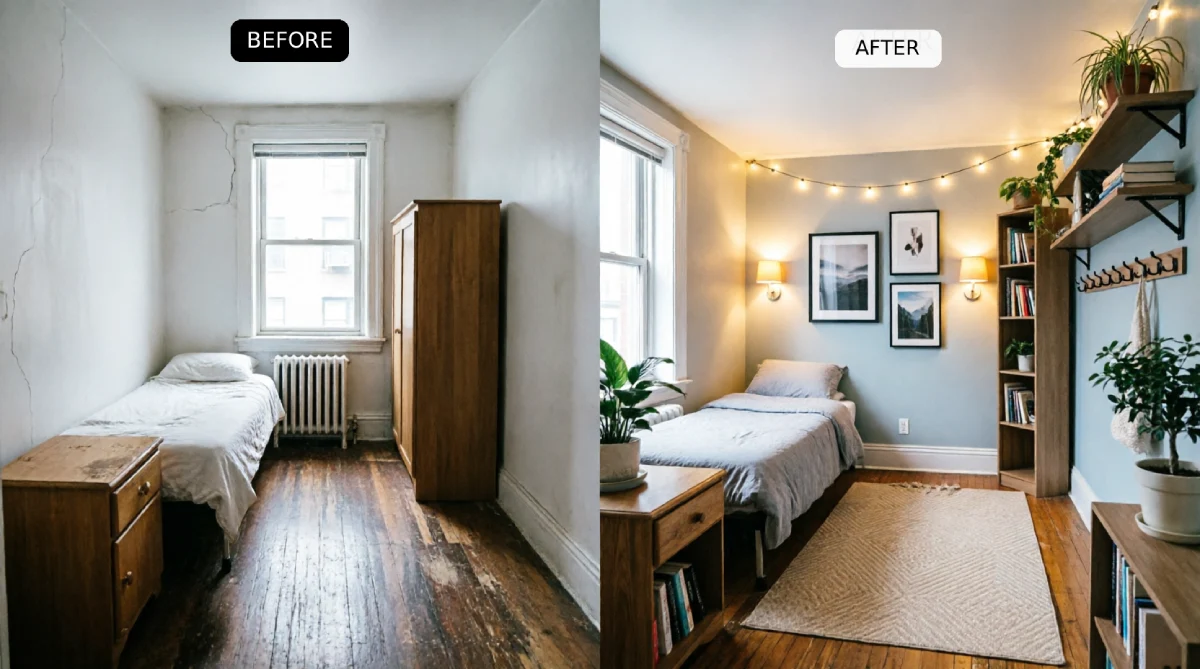
Best DIY Bedroom Decor Approaches for NYC Apartments
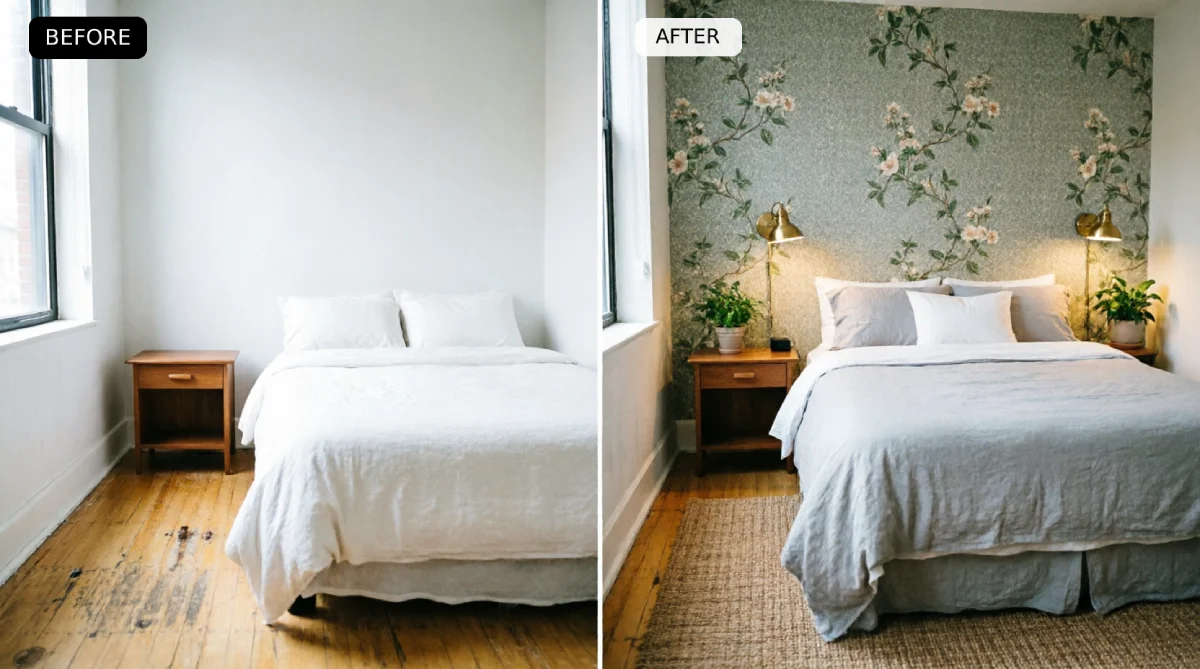
1. Peel-and-Stick Wallpaper Accent Wall
This is one of the most impactful, renter-friendly changes you can make. A single accent wall behind your bed changes the entire feel of the room without touching paint or permanent adhesive.
Brands like Tempaper, NuWallpaper, and RoomMates sell peel-and-stick wallpaper panels that come off cleanly without pulling plaster — as long as you follow removal instructions and don’t leave them up for years in high-humidity conditions.
Cost: $60–$180 for one wall, depending on pattern and brand. Available at Home Depot and online.
One practical note: NYC apartments often have radiators along walls. If your accent wall is behind a radiator, measure carefully and cut around it. The heat can cause peel-and-stick edges to lift over time, so press seams firmly and check them after the first heating season.
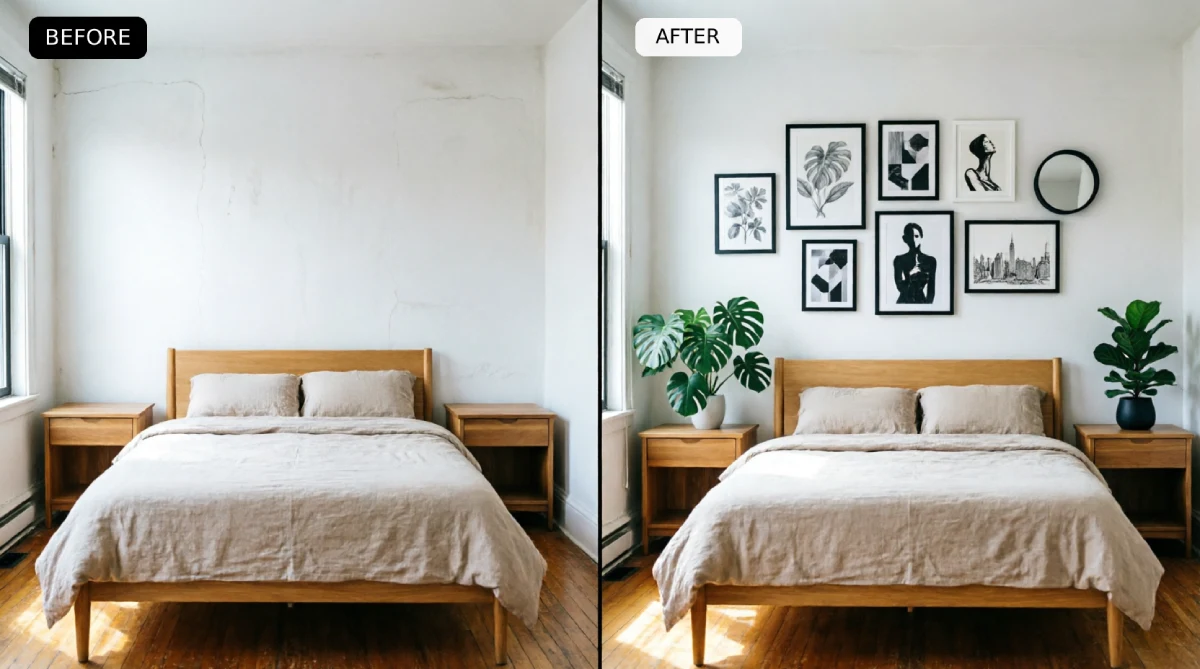
2. Command Strip Gallery Wall
Gallery walls work well in small bedrooms because they draw the eye upward and fill vertical space without taking up floor area. Command strips (3M makes the most reliable versions) hold up to 16 lbs per strip when applied correctly, which covers most framed prints and lightweight mirrors.
The key in NYC plaster-wall apartments: clean the wall with isopropyl alcohol before applying, press firmly for 30 seconds, and wait the full hour before hanging anything. Plaster walls run slightly cooler than drywall, and adhesive bonds better with a clean, room-temperature surface.
A 6-to-8-piece gallery wall using mix-and-match frames from IKEA’s RIBBA line runs about $40–$90 total. Print your own art through Canva and a local print shop like Staples or a FedEx Office location to keep costs low.
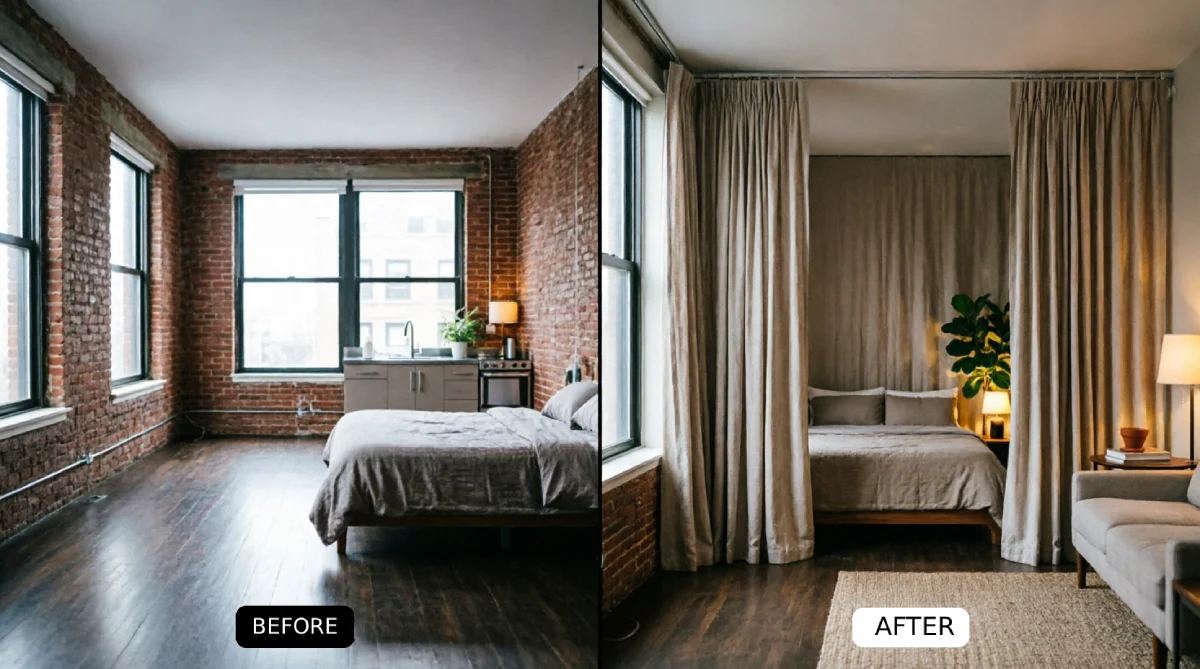
3. Curtain Room Dividers (Studio and Alcove Apartments)
If you’re in a studio or a convertible one-bedroom, curtain dividers create visual separation between your sleeping area and the rest of the apartment without any permanent construction. Use a ceiling-mounted curtain track (KVARTAL from IKEA works well) or a tension rod system for doorways.
Important: if you’re mounting a curtain track, check whether your ceiling is plaster or drywall, and use the right anchors. In most pre-war buildings, you’re hitting plaster over wood lath, which actually holds screws better than modern drywall — as long as you hit a lath strip and not just the plaster.
Curtain dividers run $50–$200, depending on fabric and hardware.
4. Floating Shelves for Vertical Storage
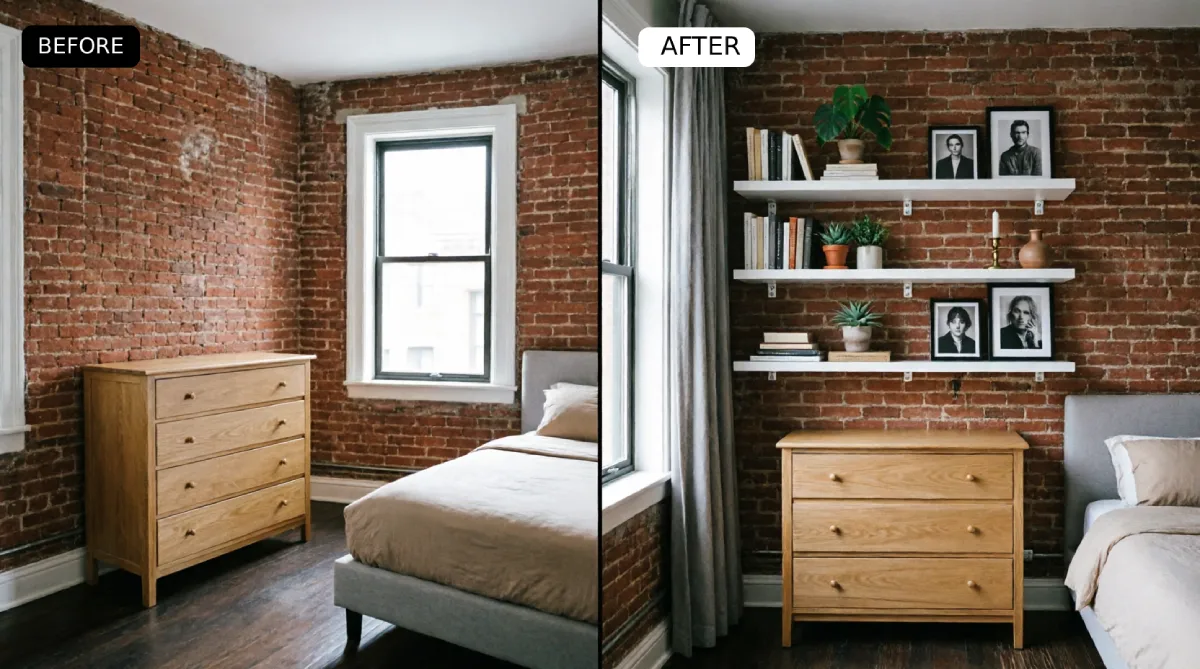
Wall space above furniture is wasted in most NYC bedrooms. Floating shelves along an empty wall or above a dresser add storage without consuming floor space.
IKEA’s LACK shelves are the most common starting point ($10–$20 each), but for plaster walls, you need to locate the wood lath behind the plaster to anchor properly. Use a stud finder set to “deep scan” mode, or knock along the wall — lath strips create a slightly higher-pitched sound than hollow plaster.
Alternatively, freestanding ladder shelves avoid wall-mounting entirely and work in almost any rental situation.
5. Under-Bed Storage with Bed Risers
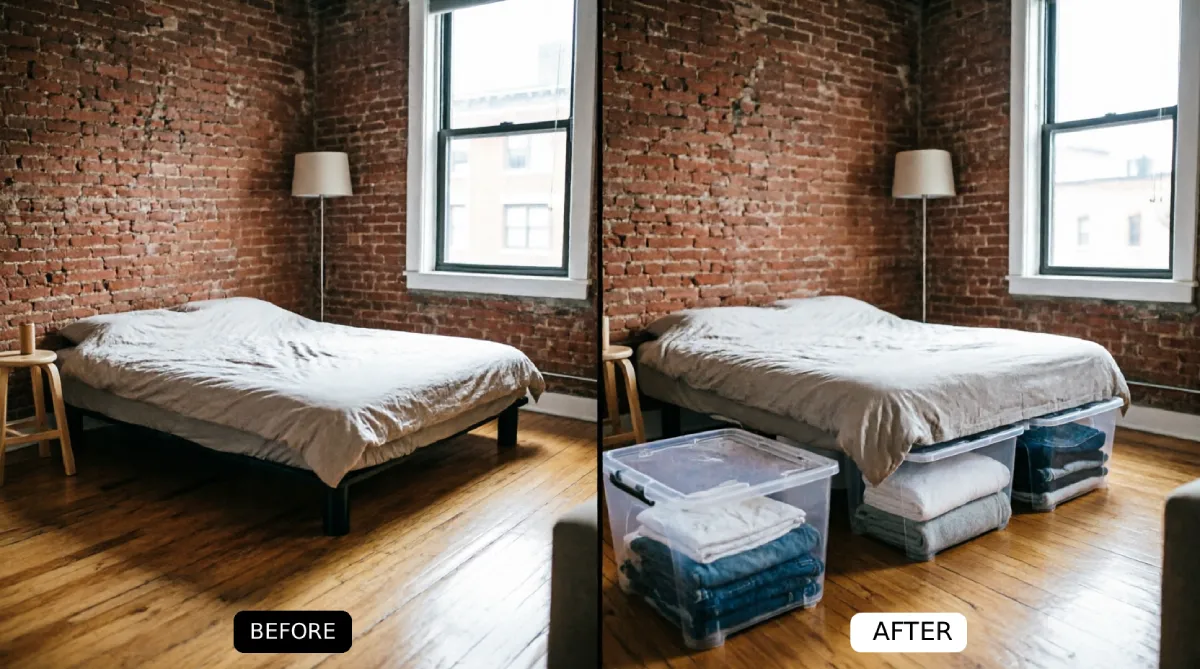
If your bed frame sits low, bed risers (available at Bed Bath & Beyond or Amazon for $15–$30) lift the frame 3–8 inches, creating usable storage space underneath. Pair with flat storage bins or vacuum-seal bags for seasonal clothing, extra bedding, or anything that would otherwise eat closet space.
This is especially relevant in NYC, where bedroom closets are notoriously undersized.
6. DIY Upholstered Headboard
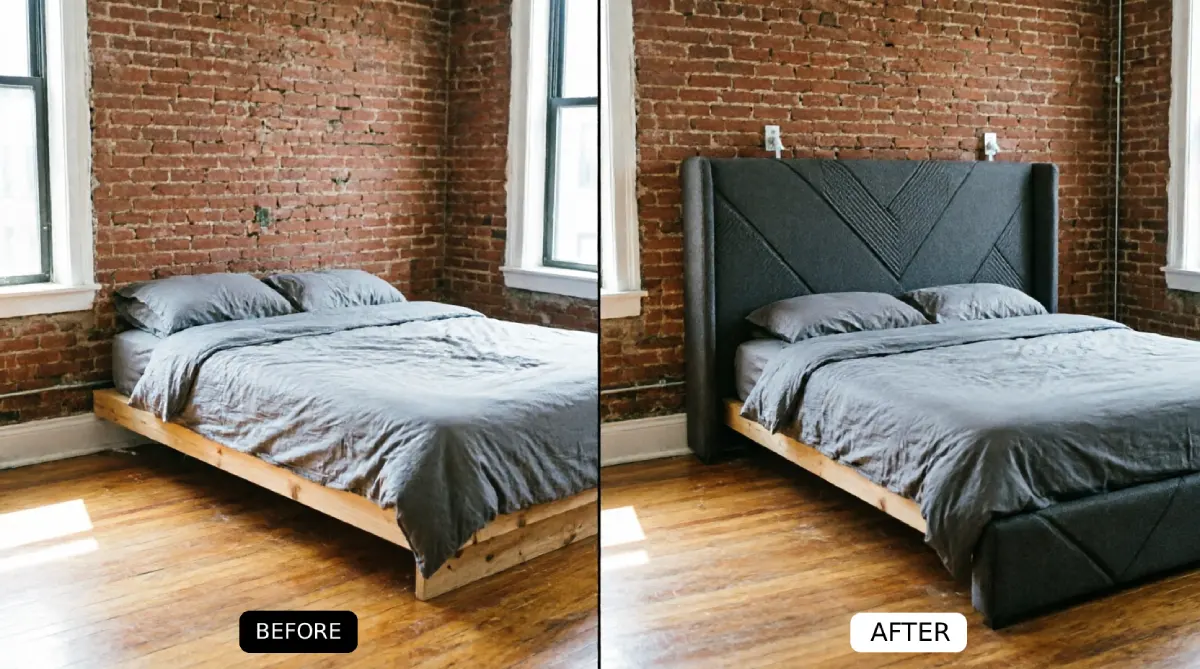
A fabric headboard attached to the wall with velcro or command strips changes the look of the room significantly. You can build a basic padded headboard from a plywood panel, foam, batting, and fabric for $60–$120, depending on size.
For renters, mount it using heavy-duty removable adhesive strips rather than hardware, or simply lean it against the wall — most queen-size headboards are stable when wedged between the mattress and wall.
7. Lighting Upgrades (No Electrician Required)
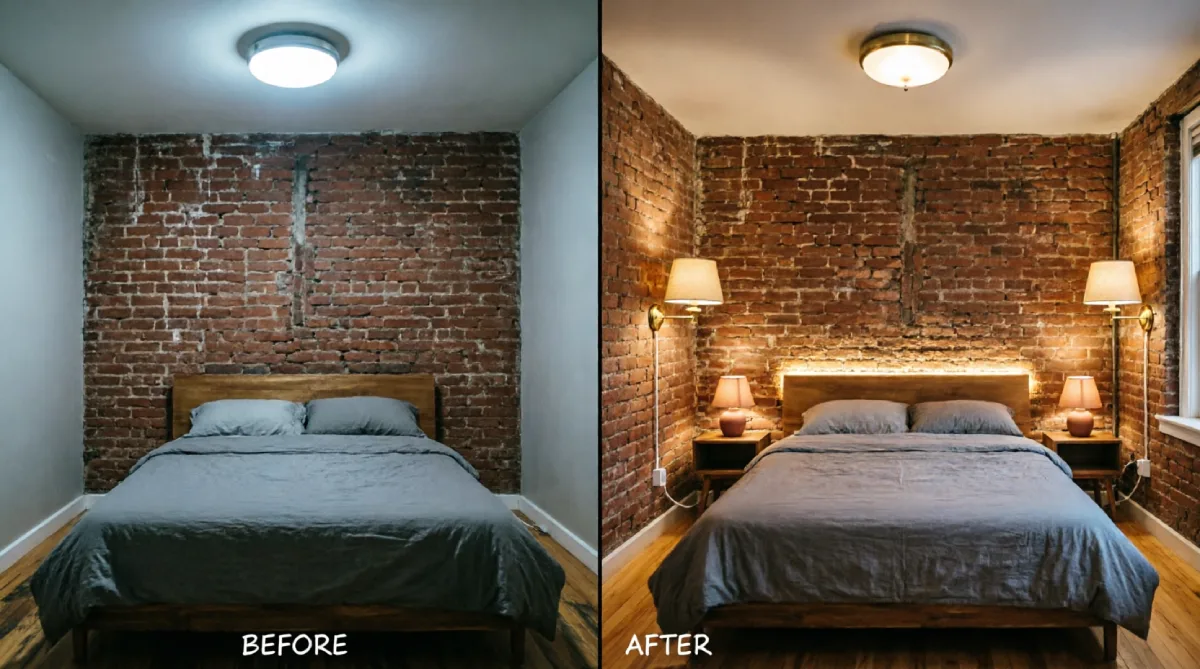
Most NYC apartment bedrooms have a single overhead fixture controlled by a wall switch — often harsh and poorly placed. You can’t rewire, but you can add:
- Plug-in sconces with cord covers ($25–$60 each) to flank the headboard
- Smart bulbs in existing fixtures ($10–$30 per bulb) to control color temperature
- Battery-operated LED strip lights behind furniture for ambient light
NYC lighting upgrades require no permits and no contractors. They’re also the fastest way to change how a room feels.
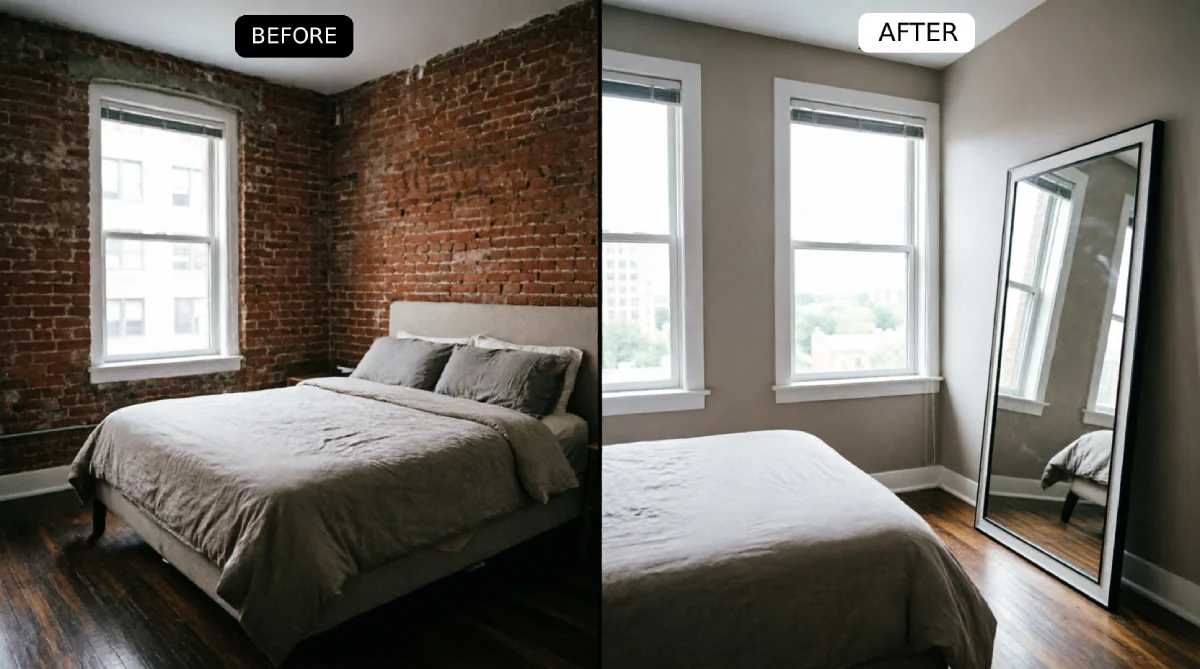
8. Mirror Placement for Light and Depth
A large floor mirror or wall-mounted mirror opposite a window reflects natural light and makes a small bedroom feel noticeably larger. A 65-inch leaner mirror from IKEA (HOVET, around $200) or Target ($80–$150) leans against the wall with no mounting required.
In north-facing NYC apartments, which often get limited direct sunlight, a well-placed mirror can meaningfully improve daytime brightness.
Cost Breakdown: DIY Bedroom Decor in New York Apartments
| Project | Low Budget | Mid Budget | High Budget |
|---|---|---|---|
| Accent wall (peel-and-stick) | $60 | $120 | $180 |
| Gallery wall (frames + prints) | $40 | $90 | $160 |
| Curtain divider system | $50 | $130 | $200 |
| Floating shelves (set of 3) | $30 | $80 | $150 |
| Bed risers + storage bins | $30 | $60 | $90 |
| DIY upholstered headboard | $60 | $100 | $140 |
| Lighting upgrades | $40 | $120 | $220 |
| Large mirror | $80 | $150 | $250 |
| Total (all projects) | $390 | $850 | $1,390 |
NYC cost note: Materials in New York City run 10–20% above the national average due to retail real estate costs and shipping to urban zip codes. If you’re buying at a physical Home Depot or IKEA location in the city (Brooklyn, College Point, or New Jersey with a car, prices are standard. Delivery fees for large items like mirrors or furniture can add $30–$80 within the five boroughs.
Common Mistakes NYC Apartment Renters Make with Bedroom Decor
Using the wrong wall anchors, standard plastic drywall anchors fail in plaster — sometimes immediately, sometimes after a few weeks when the weight settles. If your building is pre-war, assume plaster walls and use toggle bolts or plaster-specific anchors for anything over 5 lbs.
Buying furniture that doesn’t fit through the door. This is a real and recurring problem in NYC apartments. Before buying any bed frame, dresser, or large shelf unit, measure your doorway (both the bedroom door and the front door). Many NYC doors are 28–30 inches wide — narrower than standard. Assembled furniture often doesn’t make the turn in hallways. Buy in flat-pack format when possible.
Ignoring the radiator, placing furniture directly against a steam radiator is a fire risk and damages the furniture. It also blocks heat circulation. In NYC pre-war buildings with steam heat, plan your layout around the radiator — typically along an exterior wall — not as an afterthought.
Over-furnishing small rooms. A 120-square-foot bedroom with a queen bed, two nightstands, a dresser, a desk, and a chair has no breathing room. Every piece needs to justify its presence. A bed frame with built-in storage can eliminate the need for a separate dresser. A wall-mounted nightstand shelf frees up floor space that a bedside table would take.
Forgetting about lease terms before painting, some NYC landlords allow painting with written permission, but many require you to repaint in the original color before moving out. If you don’t get it in writing, you risk losing part of your security deposit, which, in NYC, given median rents, is substantial.
Buying decor for the room you wish you had. Small apartments can’t support oversized art, large rugs that extend under all the furniture, or heavy drapes that block the only window. Scale everything to the actual room dimensions, not the Pinterest image you saved.
When to DIY vs. Hire a Contractor for Bedroom Decor in NYC
For the decor projects in this article, DIY is the right call in most cases — they’re designed specifically to avoid anything that requires licensed work. But here’s where the line is:
DIY confidently:
- Peel-and-stick wallpaper
- Gallery walls with command strips or light hardware
- Curtain installations (tension rods or basic ceiling tracks)
- Plug-in lighting and smart bulbs
- Furniture assembly and arrangement
- Bed risers and under-bed storage
DIY with caution (do your research first):
- Floating shelves on plaster walls — requires correct anchors and some skill
- DIY headboard — basic carpentry, manageable for most people
- Ceiling-mounted curtain tracks — requires drilling into plaster ceiling, which can crack if done wrong
Hire a professional:
- Any electrical work beyond swapping bulbs (NYC requires a licensed electrician for rewiring)
- Permanent wall alterations requiring NYC DOB permits
- Anything your co-op or condo board requires a licensed contractor for — check your building’s alteration agreement
In NYC, unlicensed electrical work can void your building’s insurance and create liability issues for you as the tenant or owner. Don’t touch wiring.
Practical Tips for DIY Bedroom Decor in NYC Apartments
- Buy from IKEA College Point or the Brooklyn store rather than ordering for delivery — delivery in NYC for large furniture can run $50–$80, and scheduling windows are often wide
- Use isopropyl alcohol to clean walls before any adhesive application — NYC apartments accumulate grease and dust that prevent adhesive bonds from holding
- Measure doorways before buying any furniture — bring a tape measure to showrooms, not just the room dimensions
- Check your lease for the specific language on “alterations” — in NYC, this word has legal weight and usually means anything beyond hanging pictures
- Use vertical space aggressively — shelving from floor to ceiling is often more practical than wide furniture in narrow rooms
- Buy furniture with legs rather than floor-level bases — it makes the room feel taller and allows light to travel under pieces, which matters in low-light NYC apartments
- Get samples before committing to peel-and-stick wallpaper — colors look different on a phone screen than on a plaster wall under NYC apartment lighting
FAQs
How much does bedroom decor cost for an apartment in New York?
A realistic budget for meaningful DIY bedroom decor in a NYC apartment runs $400–$900 for a full refresh covering walls, lighting, storage, and furniture accents. You can do targeted upgrades (lighting + a mirror + a gallery wall) for $150–$300. High-end material choices or larger rooms push costs toward $1,200–$1,500 without touching structural elements.
Can I DIY bedroom decor in a NYC rental apartment?
Yes, with limits. Most DIY decor projects — peel-and-stick wallpaper, command strip galleries, plug-in lighting, curtain dividers — are renter-friendly and reversible. Anything involving permanent paint, wall anchors larger than picture hooks, or ceiling modifications should be cleared with your landlord in writing first.
Do I need a permit for bedroom decor in New York City?
Not for standard decor — furniture, lighting fixtures that plug in, removable wall treatments, and shelving don’t require NYC DOB permits. Permits are required for structural changes, electrical rewiring, or alterations that affect the building’s systems. NYC has strict enforcement, especially in co-op buildings that have their own alteration approval processes separate from the city.
Is DIY bedroom decor worth it for NYC apartment renters?
Yes, specifically when you focus on reversible projects. You’re likely paying high rent for a space that feels generic — making it functional and personal has real quality-of-life value. The risk is investing heavily in a rental you might leave in a year or two. Prioritize portable improvements (furniture, mirrors, lighting) over fixed ones (wallpaper, shelving) unless you have a long-term lease.
What’s the best way to make a small NYC bedroom look bigger?
Three things that actually work: a large mirror opposite the window to reflect light, furniture with legs instead of solid bases to create visual space underneath, and keeping the color palette light and consistent across walls, bedding, and major furniture pieces. Decluttering has more impact than any decor purchase — in 120 square feet, visible clutter shrinks the room fast.
Can I paint my apartment bedroom in NYC without landlord permission?
Technically, most NYC leases prohibit painting without landlord approval. In practice, many landlords allow it informally. The risk is that if you don’t get written permission and paint a non-standard color, you may be required to repaint before moving out at your own expense — and you’ll be held to the original color, not whatever you chose. Get it in writing if you want to paint.
Conclusion
Bedroom decor in a New York apartment is a problem-solving exercise before it’s a creative one. The constraints are real: small square footage, plaster walls, lease restrictions, co-op board rules, and furniture that has to function as storage, not just decoration.
The projects in this guide are chosen because they work within those constraints — not around them. Start with the items that have the most visual impact for the least commitment: lighting, a mirror, and a gallery wall. Then work toward storage solutions that recover floor space without requiring contractor work.
Before spending anything, pull out your lease and identify what’s actually off-limits in your specific building. That one step saves more money and stress than any decor tip.
Work with the room you have, not the room you wish you had. The best NYC apartments aren’t the biggest ones — they’re the ones where every square foot is doing something useful.
