

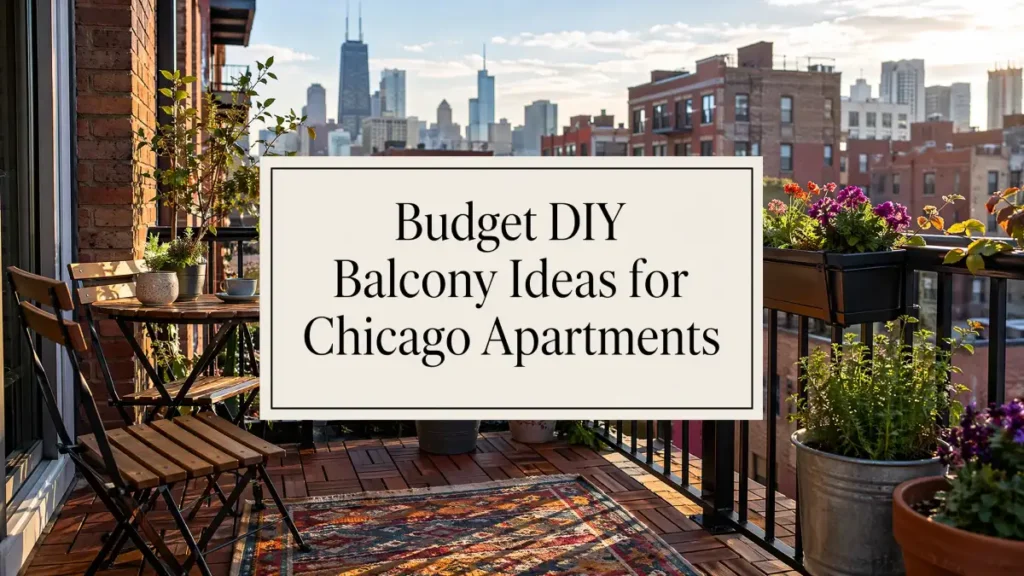
My neighbor in a Lincoln Park high-rise spent three summers looking at a bare concrete balcony before she finally did something about it, and she did it for under $300. No contractor, no permit headaches, no HOA drama. Just smart planning and a couple of weekend trips to Home Depot on Halsted.
If you live in a Chicago apartment, whether it’s a vintage courtyard building in Lakeview, a newer condo tower in the West Loop, or a two-flat in Logan Square, your balcony is probably underused. Chicago weather doesn’t make it easy. You’ve got brutal winters, unpredictable spring winds, summer humidity, and maybe only four or five truly comfortable months outdoors. That makes it even more important to set up your balcony so you actually use it when the weather allows.
This guide covers practical DIY balcony ideas built for Chicago apartment living: what works in a small urban space, what the city actually allows, what things cost, and where to buy them. No filler, no vague inspiration boards — just what you need to get it done.
Understanding DIY Balcony Makeovers for Chicago Apartments
Before you buy anything, you need to understand the specific limits that come with Chicago apartment balconies.
Weight limits matter more than you think. Chicago high-rise and mid-rise balconies are engineered for specific loads. Most residential balconies in Chicago handle between 40 and 60 lbs per square foot. A small balcony (5×8 ft = 40 sq ft) can hold around 1,600–2,400 lbs, which sounds like a lot until you stack a heavy planter, a tile floor covering, a furniture set, and a few people on it at once. Always err on the lighter side. Use lightweight materials: resin furniture, fabric planters, foam-core outdoor rugs.
Your lease controls more than the city does. Chicago has no specific municipal ordinance banning balcony decor, but most apartment leases and condo HOA rules restrict things like:
- Permanent structures or drilling into concrete railings
- Gas grills (most Chicago high-rises ban open flame on balconies — electric or small propane tabletop grills are usually the workaround)
- String lights attached directly to the building structure
- Large planters on railing tops (liability issue)
Read your lease before you spend a dollar. If you’re in a condo, pull up the HOA rules. Many Chicago condo associations, especially in River North and the South Loop, have specific balcony policies.
Chicago’s climate shapes every decision. You’re dealing with:
- Wind: Lake Michigan wind is no joke. Anything not anchored will end up on the street below.
- UV damage: Summer sun on a south-facing balcony will fade cheap outdoor fabrics in one season.
- Freeze-thaw cycles: Anything porous left outside through winter — terracotta pots, cheap wood — will crack or warp.
Material choices that ignore Chicago’s climate will cost you twice — once to buy, once to replace.
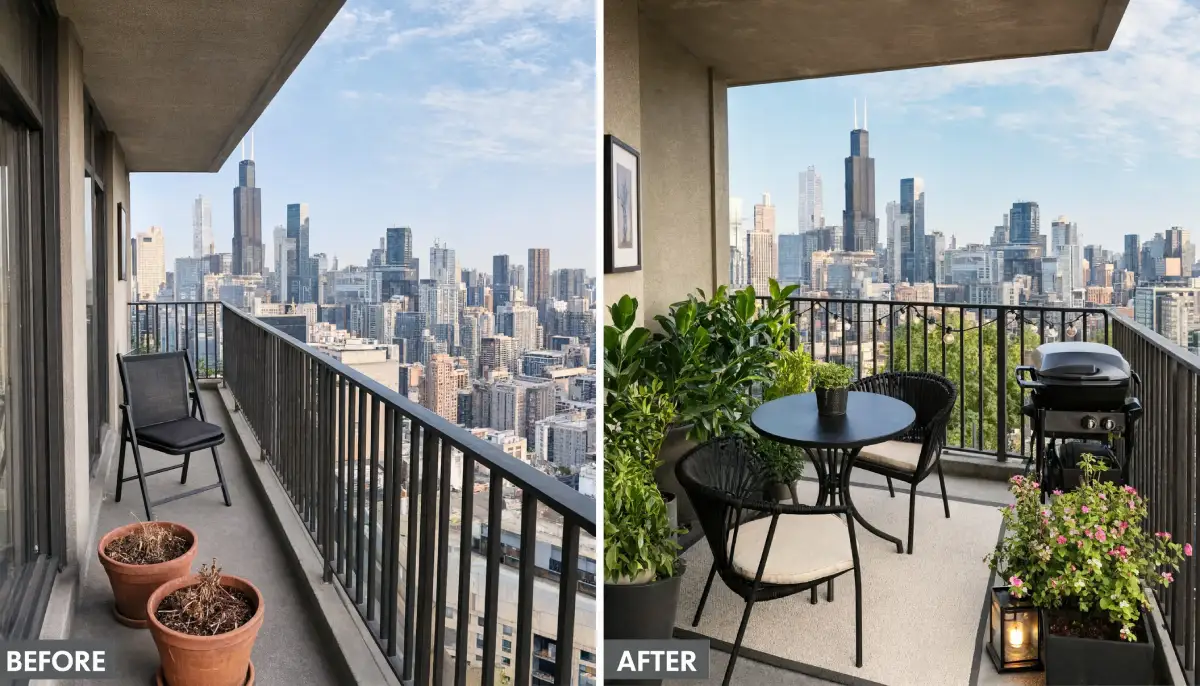
Best DIY Balcony Ideas for Chicago Apartments
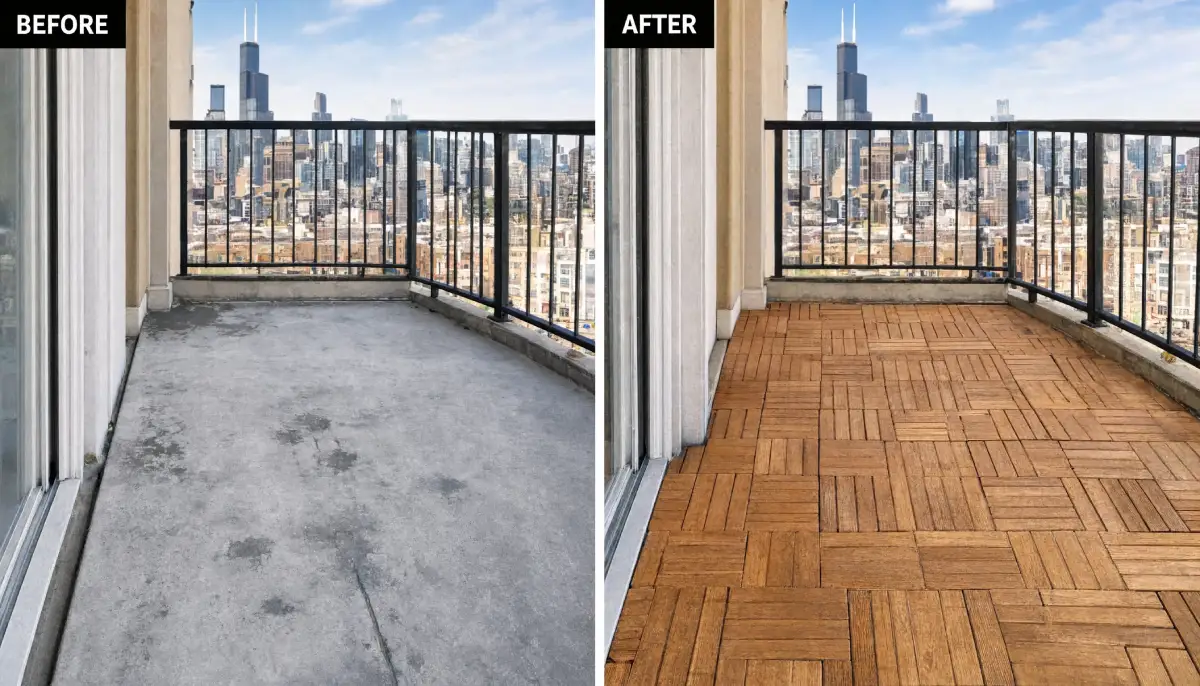
1. Interlocking Deck Tiles
This is the single most impactful upgrade you can make. Bare concrete looks depressing and feels cold underfoot. Interlocking deck tiles (wood, composite, or stone-look porcelain) snap together without adhesive, require no drilling, and can be picked up and moved when you leave.
- Best picks: Acacia wood tiles ($2–$4/sq ft at Home Depot), composite tiles ($3–$5/sq ft), or porcelain snap tiles ($4–$7/sq ft)
- Chicago note: For balconies exposed to full winter, go with composite or porcelain over real wood. Acacia holds up reasonably well but needs annual sealing if you leave it out year-round. Most Chicago apartment dwellers stack and store tiles indoors from November to March.
- Cost for a 5×8 balcony: $80–$280 in materials
2. Vertical Garden Wall
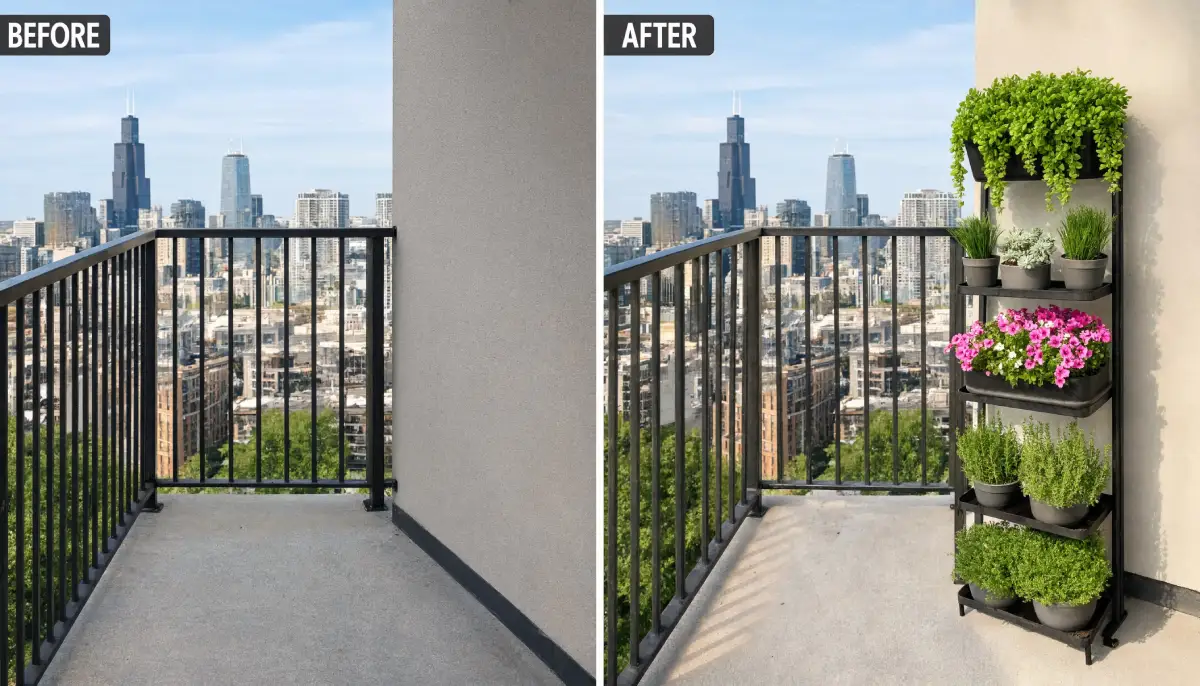
Horizontal space on a Chicago apartment balcony is limited. Go vertical. A wall-mounted pocket planter or a freestanding vertical garden rack solves two problems: adds greenery without eating floor space, and can act as a partial wind break.
- Best approach: Freestanding tiered plant stands (no drilling required) — around $35–$80 at Target or Amazon
- Plants that survive Chicago balcony conditions: Sedums, ornamental grasses, petunias, and herbs like rosemary and thyme handle wind and heat better than most. Avoid tall, top-heavy plants — they’ll blow over.
- For north-facing balconies (common in Chicago courtyard buildings): Stick to shade-tolerant plants — ferns, impatiens, hostas.
3. Outdoor Rug
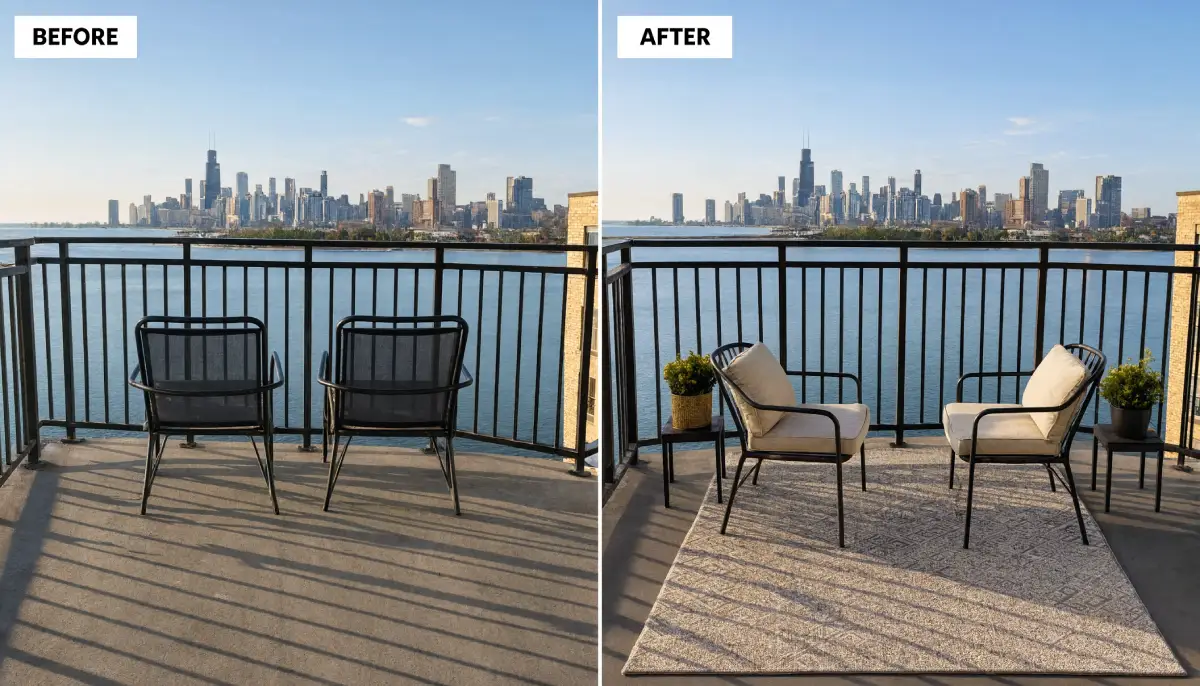
An outdoor rug does more work than it gets credit for. It defines the space visually, softens the concrete, and makes the balcony feel like an actual room. It also adds a layer of insulation underfoot in cooler months.
- What to buy: Polypropylene rugs are the only material worth considering for Chicago. They resist mold, dry fast, and handle freeze-thaw without cracking. IKEA’s UTENDORS line and Ruggable outdoor rugs are solid picks in the $40–$120 range.
- Sizing: For a standard Chicago apartment balcony (4×6 to 5×8 ft), a 4×6 rug is the sweet spot. Don’t go wall-to-wall — leave a few inches on each side so water drains freely.
- Critical: In winter, bring the rug inside or roll and store it. Leaving a wet rug frozen to concrete for months will ruin both.
4. Freestanding Privacy Screen
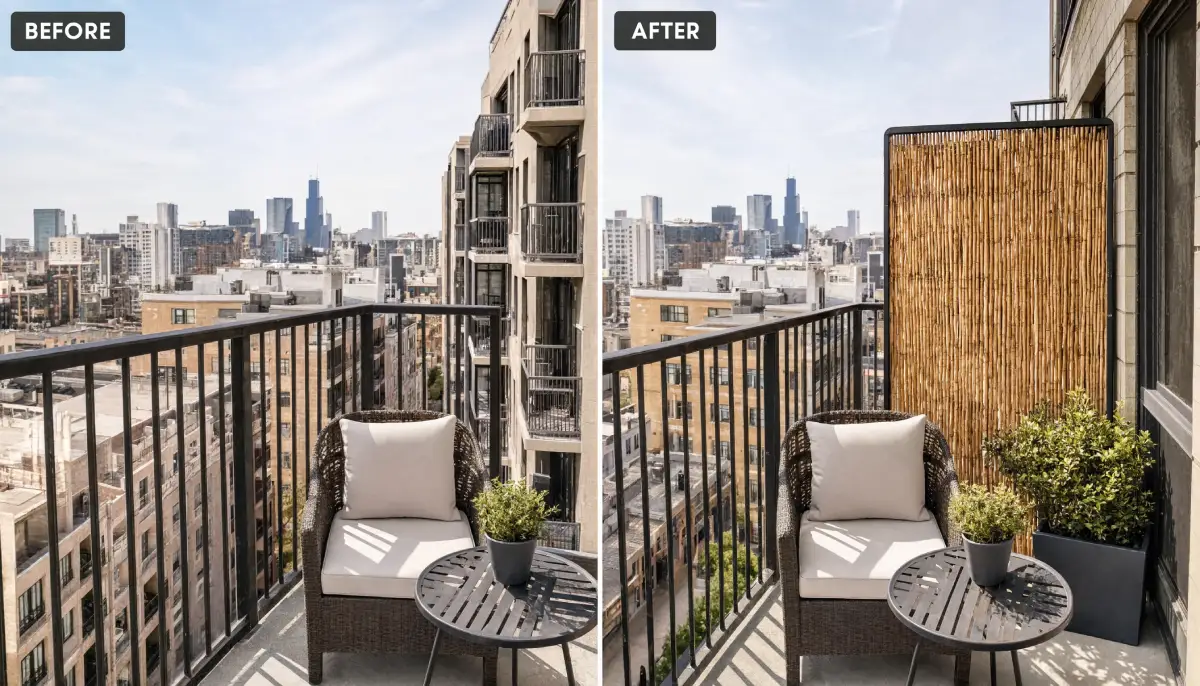
Chicago apartment balconies are often stacked directly above or beside neighbors. A freestanding privacy screen (bamboo roll, weather-treated wood slat panel, or outdoor fabric panel) adds privacy and cuts wind without touching the building structure.
- Best option: Freestanding bamboo privacy screens with weighted bases — $60–$150 on Amazon or at Menards in the Chicago suburbs
- Wind warning: Any screen that catches wind is a projectile risk. Weight the base with sandbags or heavy planters. On high-floor balconies (above the 10th floor in Chicago’s high-rises), reconsider this idea — wind speeds are significantly higher, and most screens aren’t built for it.
5. String Lights (Done Right)
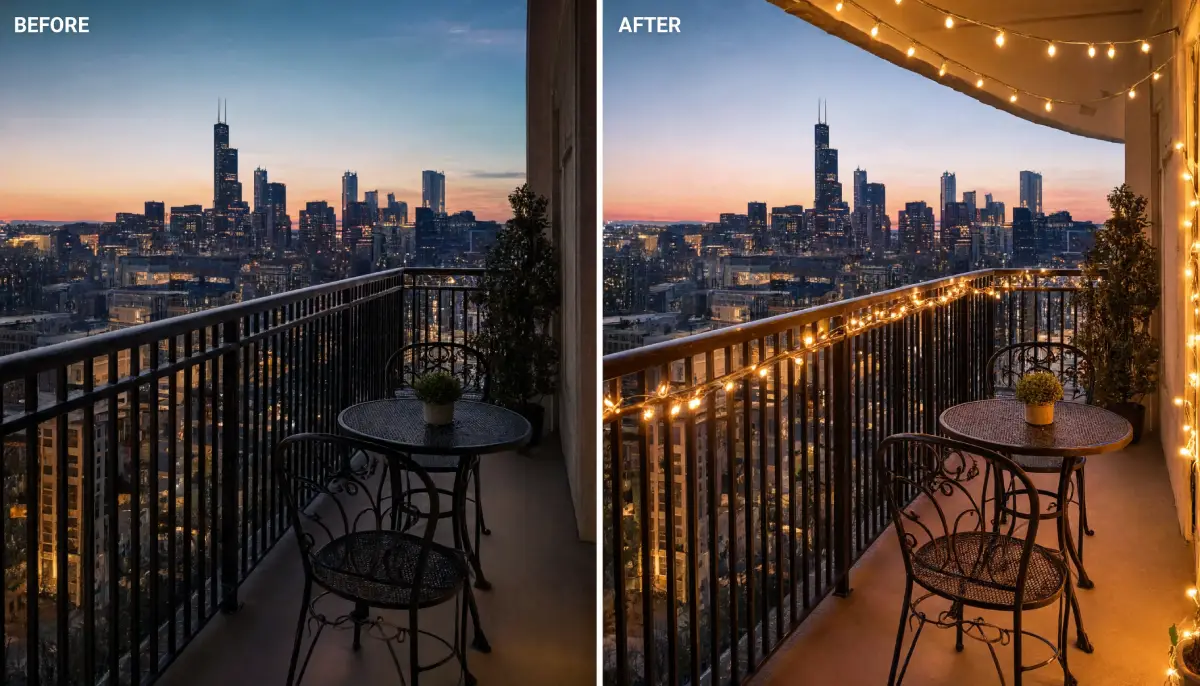
String lights are popular for a reason — they extend usable balcony hours into the evening and change the feel of the space completely. The challenge in Chicago apartments is how to hang them without drilling.
- No-drill solutions: Adhesive hooks rated for outdoor use (3M Command Outdoor hooks handle up to 7.5 lbs and survive Chicago rain, though reapply annually), clip-on railing hooks, or wrap lights around a freestanding plant stand
- Bulb type: Always use shatter-resistant LED bulbs for balconies. Glass bulbs + Chicago wind = broken glass on your downstairs neighbor’s balcony
- Cost: A solid 25-ft S14 LED string light set runs $20–$45 at Home Depot
6. Compact Seating That Actually Fits
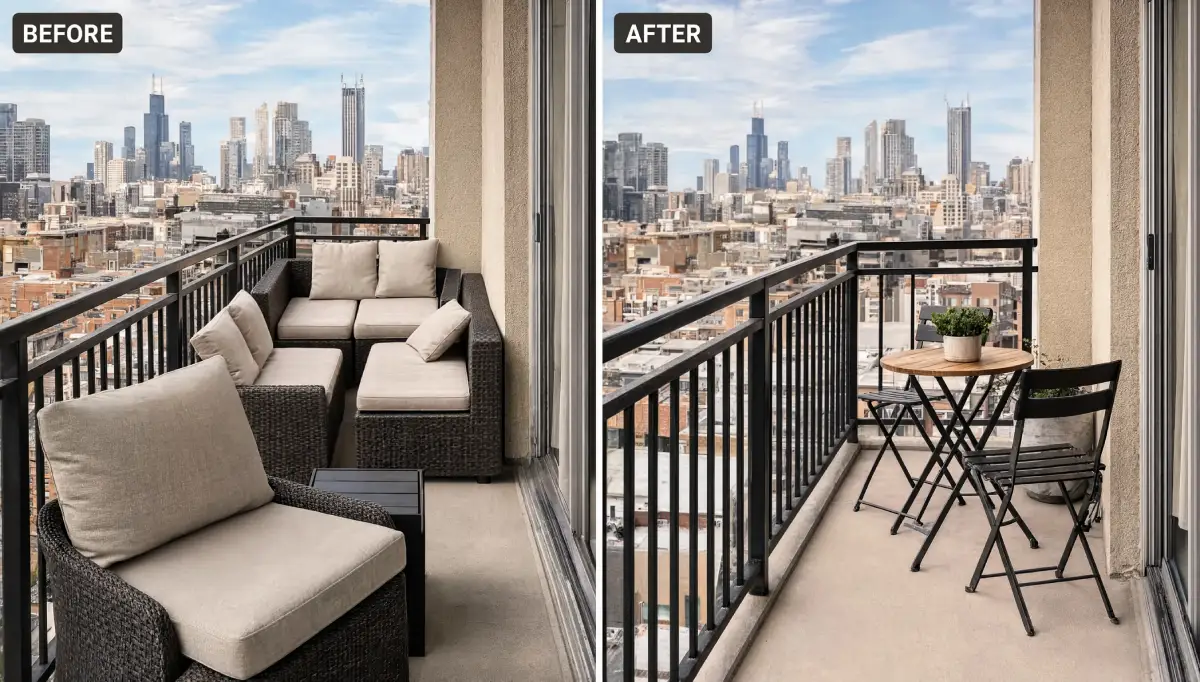
Most apartment balconies in Chicago run 4–6 ft deep. Standard patio furniture doesn’t fit. You need to think differently.
Best options:
-
- Folding bistro sets (two chairs + small table): $60–$150, fold flat against the wall when not in use
- Stackable resin chairs: $20–$40 each at Target, lightweight, weather-proof
- Floor cushion seating with a low coffee table: works well on tiled balconies, very low profile
Avoid: Deep-seated lounge chairs, large sectionals, or anything that requires more than 3 ft of depth — you’ll end up with furniture that blocks the door
7. Portable Planter Boxes with Railing Hooks
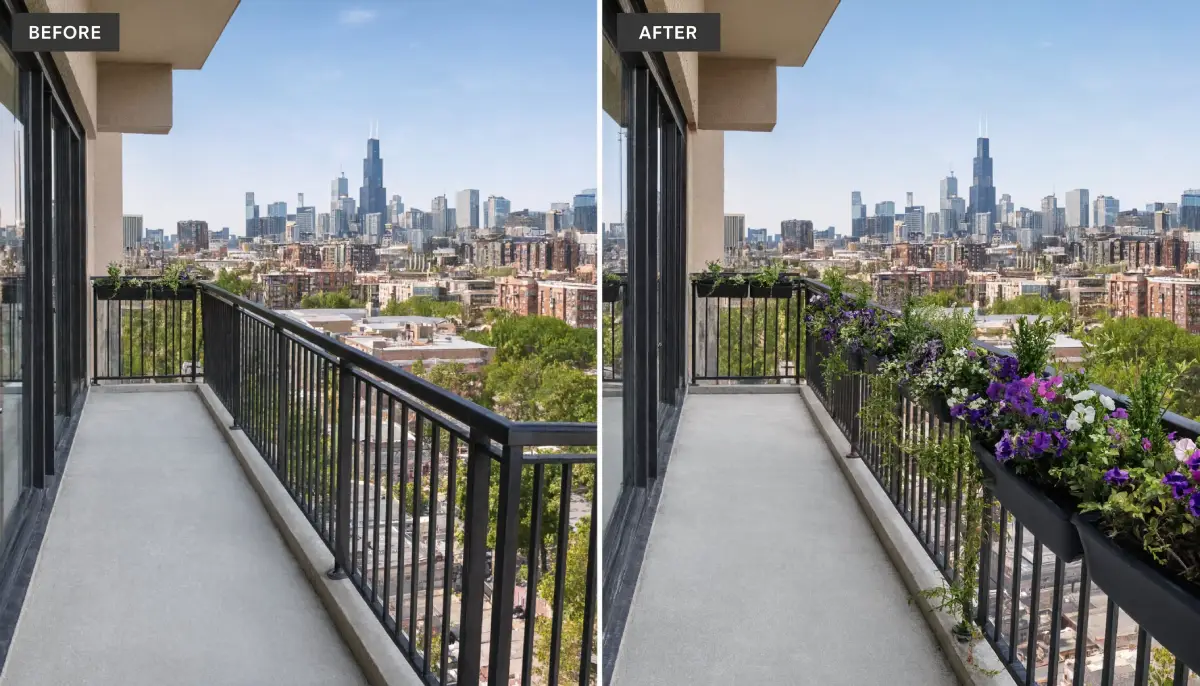
Railing planter boxes are one of the most space-efficient DIY balcony ideas available. They hang on the outside of the railing (or inside, if your HOA requires it) and add color without using any floor space.
- Chicago-specific concern: Check that your railing can support the weight — filled planter boxes can weigh 15–30 lbs each. Wrought iron railings, common in Chicago’s vintage buildings, handle this fine. Thin aluminum railings in newer construction may not.
- Cost: Railing planter boxes run $15–$40 each at Home Depot or Lowe’s on Elston Ave
8. Outdoor Side Table with Storage
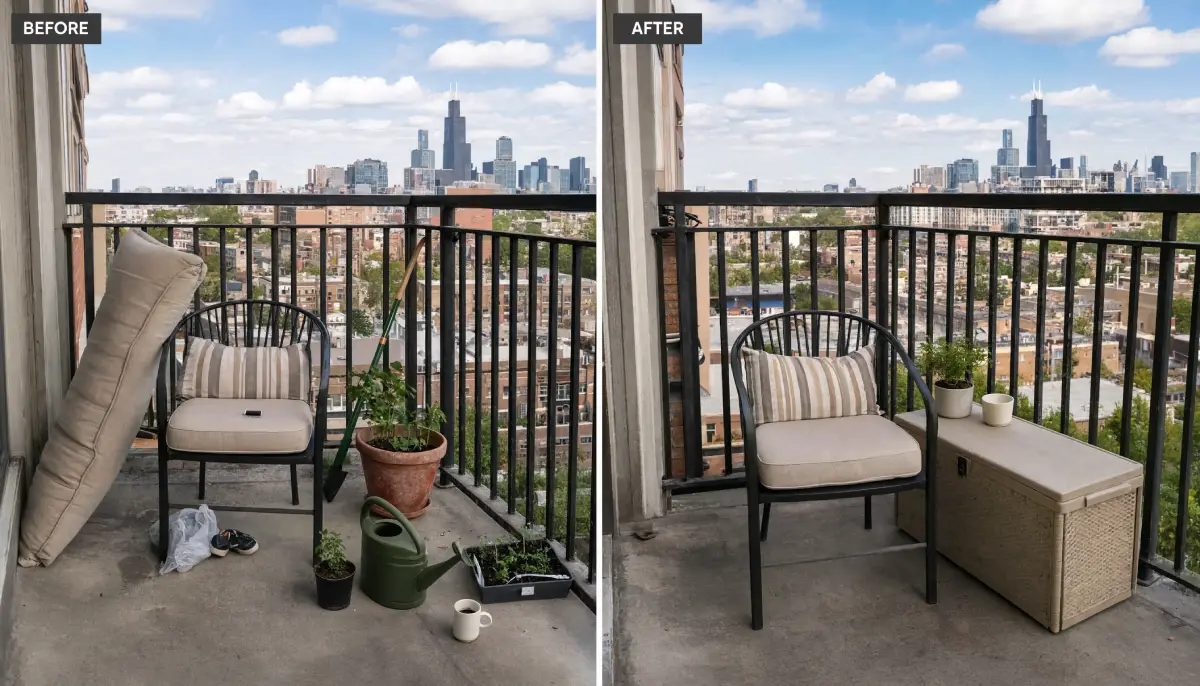
On a small balcony, every piece of furniture needs to do double duty. A small outdoor storage box (also called a deck box) can serve as a side table, extra seating, and storage for cushions and tools.
- Good pick: Keter or Suncast deck boxes in the 30–60 gallon range — $60–$130, weatherproof, lightweight, and widely available at Home Depot
- Bonus: Storing cushions and outdoor fabrics in a deck box between uses extends their life significantly in Chicago’s variable climate
DIY Balcony Makeover Cost Breakdown
| Item | Low Budget | Mid Budget | High Budget |
|---|---|---|---|
| Floor covering (deck tiles or rug) | $40–$80 | $100–$180 | $200–$350 |
| Seating (chairs + table) | $60–$100 | $150–$250 | $300–$600 |
| Planters + plants | $30–$60 | $80–$150 | $200–$400 |
| Privacy screen | $0 (skip) | $60–$100 | $120–$250 |
| String lights | $20–$35 | $40–$70 | $80–$150 |
| Storage/side table | $0 (skip) | $60–$100 | $130–$250 |
| Miscellaneous (hooks, ties, soil) | $15–$30 | $30–$50 | $50–$80 |
| Total Estimate | $165–$305 | $520–$900 | $1,080–$2,080 |
Chicago cost note: Material costs at Chicago-area stores (Home Depot on Halsted, Lowe’s in Lincoln Park, Menards in Skokie or Bridgeview) are generally in line with national pricing. You won’t face the labor cost markups that hit NYC or San Francisco because this is all DIY — no contractors involved. Shipping costs on bulky items like deck tiles and furniture can add $30–$80 if ordering online; in-store pickup saves that.
Common Mistakes Chicago Apartment Balcony Owners Make
- Buying furniture before measuring. This sounds basic, but it’s the most common mistake. Chicago apartment balconies vary widely — from 3.5 ft deep in some Streeterville high-rises to nearly 8 ft in some Wicker Park two-flats. Measure depth, width, and the door swing clearance before purchasing anything.
- Ignoring wind direction. In Chicago, wind typically comes off Lake Michigan from the east and northeast. An east-facing balcony with no wind protection will be nearly unusable in spring and fall. A west-facing balcony in a courtyard building might be perfectly sheltered. Know your exposure before buying plants or privacy screens that depend on calm conditions.
- Using cheap wood furniture. Discount pine or untreated wood outdoor furniture left on a Chicago balcony through a single winter will warp, crack, and grow mold by spring. Either bring wood furniture inside from November to March, or skip it entirely and go with resin, powder-coated aluminum, or teak (which is weather-resistant but expensive).
- Overloading the balcony. More stuff does not equal a better balcony. A small Chicago apartment balcony with one bistro set, a rug, and two planters looks intentional. The same balcony crammed with five plants, a grill, two chairs, a lounger, and a storage box looks like a storage unit. Edit ruthlessly.
- Skipping the lease review. Spending $500 on balcony improvements only to get a notice from your building manager about lease violations is a real scenario. It happens. Read your lease first — takes 20 minutes and could save you the entire budget.
- Terracotta pots left outside in winter. Terracotta is porous. Water seeps in, freezes, and the pot cracks. Either bring terracotta inside before the first hard freeze (usually mid-to-late October in Chicago), or switch to resin, fiberglass, or fabric grow bags — all of which survive Chicago winters fine outdoors.
When to DIY vs. Hire a Contractor for Balcony Work in Chicago
For the scope of this article — decorating, furnishing, and planting a Chicago apartment balcony — there is almost no scenario where you need a contractor.
DIY Everything Listed Here:
Deck tiles, rugs, furniture, planters, string lights, and privacy screens — all of it is designed to be installed without tools or with basic hand tools. None of it requires permits in Chicago when done as described (no permanent attachment to the building structure).
The line where you need a contractor (or at minimum, building management approval):
- Structural repairs to the balcony itself — cracks in concrete, rust on railings, loose anchors
- Any electrical work — adding an outdoor outlet, hardwiring lights
- Permanent flooring is adhesively bonded to the concrete slab
- Any modification to the railing height or structure
If you notice structural issues with your balcony — spalling concrete, rust staining running down from railings, soft spots — stop decorating and report it to your building management immediately. Chicago has had real balcony collapse incidents (the 2003 Lincoln Park balcony collapse being the most cited case), and structural issues are not something to work around.
For structural repairs, you’re not hiring a contractor — your building management is responsible for that, and in Chicago, they’re required to address it under the Chicago Residential Landlord Tenant Ordinance (RLTO).
Practical Tips
- Shop end-of-season sales. Home Depot and Lowe’s in Chicago mark down outdoor furniture and planters 50–70% starting in late August. Buy for next year, store indoors.
- IKEA Bolingbrook is one of the best sources for affordable outdoor accessories in the Chicago area — their HUSARÖ and ÄPPLARÖ lines offer reasonable weather resistance at low prices.
- Use zip ties and bungee cords to secure lightweight items (plant hangers, light strands) to railings without drilling. Replace annually — UV degrades them.
- Weight down anything that can blow. Use heavy river rocks in planters, sandbag bases on screens, and always check forecasts before leaving light items unsecured overnight. Chicago wind advisories are common from spring through fall.
- A $10 outdoor thermometer/hygrometer placed on your balcony tells you the actual microclimate — useful for choosing plants and understanding why some areas of your balcony get dramatically hotter or more humid than others.
- Fabric grow bags ($5–$15 for a pack) are the best planter solution for a Chicago apartment balcony — lightweight, freeze-proof, foldable for winter storage, and surprisingly durable.
- For north-facing Chicago balconies, skip the sun-loving annuals that dominate garden center displays in May. They will disappoint you. Go shade-tolerant from the start.
FAQs
How much does a DIY balcony makeover cost in Chicago?
A basic Chicago apartment balcony setup — rug, a bistro set, a few planters, and string lights — runs $165–$305 on the low end. A more complete setup with deck tiles, quality furniture, privacy screens, and a planter wall lands in the $520–$900 range. High-end DIY with premium materials can reach $1,000–$2,000, though at that point you’re approaching what some contractors charge for a basic balcony refresh.
Can I DIY my balcony in a Chicago apartment?
Yes, with a clear scope. Everything covered in this guide — furniture, rugs, deck tiles, planters, lights, privacy screens — is renter-friendly DIY that doesn’t require permits or permanent modifications. The key constraint is your lease. Some Chicago apartment buildings, particularly managed high-rises in the Gold Coast or Streeterville, have specific rules about balcony decor. Confirm before you buy.
Do I need a permit for balcony work in Chicago?
For decorative work (furniture, rugs, planters, lights) — no permit needed. For any structural changes, electrical additions, or permanent modifications to the building itself, you’d need Chicago Department of Buildings permits. But nothing in a standard DIY balcony makeover triggers that threshold.
Is a DIY balcony makeover worth it for a Chicago apartment?
If you’re in a multi-year lease and you use the space, yes. A $300 investment that gets you 5 months of outdoor use annually is worth it. If you’re month-to-month or leaving in six months, keep it minimal — a rug, one plant, and a folding chair. Don’t over-invest in a temporary space.
What furniture works best on small Chicago apartment balconies?
Folding bistro sets are the most practical for Chicago’s compact balconies. They fold flat against the wall or door when not in use, freeing floor space. Stackable resin chairs are also solid, lightweight, weatherproof, and storable indoors during winter without taking up much space.
How do I protect balcony items through a Chicago winter?
The short answer: bring in anything that can be damaged by freeze-thaw cycles. That means cushions, fabric items, terracotta pots, real wood furniture, and outdoor rugs. Deck tiles (composite or porcelain), resin furniture, and metal frames can generally stay out but benefit from being covered with a breathable outdoor furniture cover — available at Home Depot for $20–$50.
Conclusion
A Chicago apartment balcony is a small space with real seasonal limits — but it’s also usable outdoor space in a city where that isn’t easy to come by. The goal isn’t to make it look like a magazine cover. The goal is to make it a place you actually go.
Start with the floor (deck tiles or a rug), add seating that fits your actual balcony dimensions, and bring in some plants. From there, add what serves a specific purpose — privacy, storage, lighting. Every item you add should earn its place.
Check your lease before spending a dollar. Choose materials built to handle Chicago winters. And keep it simple — a well-edited small space is always more usable than a crowded one. A weekend and a few hundred dollars is all it takes to go from bare concrete to a balcony you’ll actually use from May through October.
