

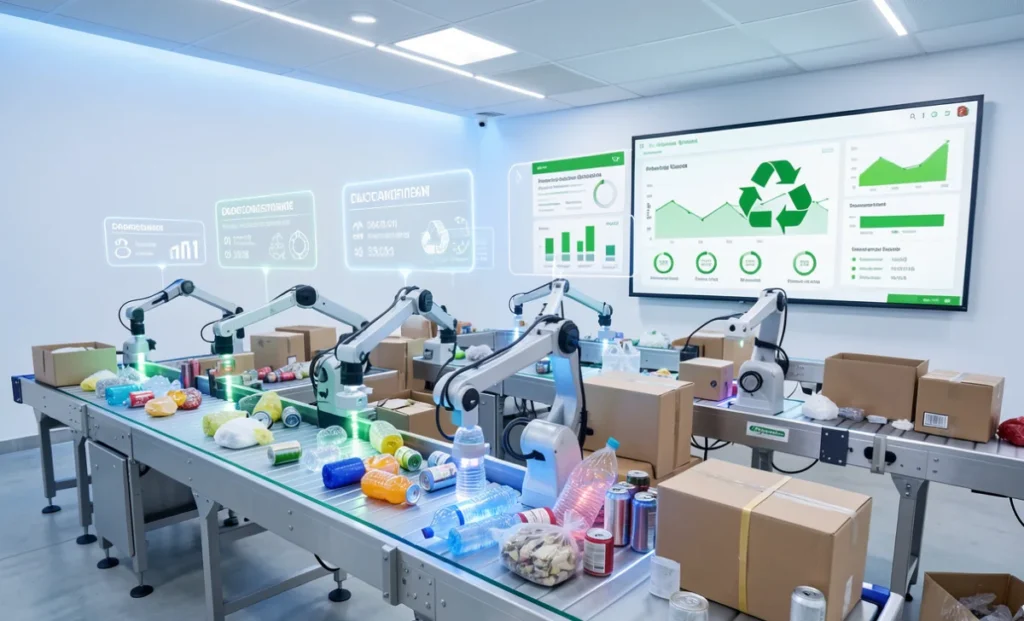
As a waste sorting automation leader, MataRecycler’s AI-powered waste sorting platform uses computer vision, machine learning, and IoT-connected smart bins to identify and separate recyclable materials. This automated recycling system replaces manual sorting with smart waste classification technology, reducing contamination and improving material recovery rates for municipalities and commercial facilities.
Here’s how it works: sensors scan what you toss in, AI figures out what’s what, and smart mechanisms shoot each item into the right bin—all in seconds. Facilities using MataRecycler see fewer mistakes, lower bills, and cleaner bales of recyclables that buyers actually want—and pay more for.
What Traditional Recycling Gets Wrong
Traditional recycling programs struggle with one persistent problem: contamination. When recyclables get mixed with food waste or the wrong materials, the entire batch often ends up in a landfill. In the US, contamination rates in single-stream recycling programs have historically reached 25% or higher, a figure that waste management industry groups have tracked for years.
Manual sorting compounds the issue. It is slow, error-prone, and expensive. Sorting facilities rely on workers to make fast decisions about items moving on conveyor belts at high speed. Accuracy drops further whenever packaging formats change, which happens constantly as consumer goods manufacturers update their materials.
Fixed collection routes add another layer of inefficiency. Trucks run on schedules regardless of whether bins are full, wasting fuel and labor on unnecessary trips. In a well-run urban system, that inefficiency quietly inflates costs and emissions year over year.
What MataRecycler Actually Does
MataRecycler is an integrated platform, not a single piece of hardware. It connects smart bins, optical scanning equipment, machine learning models, and a cloud-based analytics dashboard into one operating system for waste management.
The core function is material identification. High-speed cameras and near-infrared (NIR) spectroscopy sensors capture spectral signatures of each item moving through the waste stream. The AI model analyzes shape, texture, color, and density to classify materials, including PET plastic, HDPE, aluminum, corrugated cardboard, and mixed paper—even when labels or colors change.
What separates it from older sorting equipment is the learning component. Each sorting decision feeds back into the model via its continuous learning loop, and the platform retrains its classification model quarterly using newly sorted material data. With continuous machine learning feedback, MataRecycler’s classification accuracy improves by ~2-5% per quarter of operational data, adapting to newer packaging formats that older rule-based machines cannot handle.
The Three-Stage Sorting Process
MataRecycler’s sorting happens in three real-time stages: Detection (cameras scan), Classification (AI identifies), Action (actuators sort)—all in under 0.5 seconds per item.
- Detection. Cameras and optical scanners capture the waste stream in real time.
- Classification. The machine learning model identifies material type and condition.
- Action. Mechanical actuators, including air jets and magnetic separators, divert each item into the correct output bin.
Each item gets sorted in under half a second—faster than a human blink, and infinitely more consistent.
Key Features Worth Knowing
Beyond sorting accuracy, MataRecycler includes components that address the full recycling workflow.
Smart bins with fill-level sensors monitor capacity in real time and send alerts when collection is needed. This removes fixed-route scheduling and lets operators dispatch trucks only when bins require it, reducing both collection costs and fuel consumption.
The cloud analytics dashboard gives facility managers and municipal operators a live view of sorting accuracy, material volumes, error rates, and route efficiency. This data helps identify where the process breaks down and where the biggest operational gains are available.
For user-facing engagement, the platform includes a mobile app that tackles recycling’s biggest leak: resident confusion. Using behavioral nudging and gamification mechanics, the app guides proper disposal in real time, rewards correct sorting with points, and shows neighborhoods their collective impact—so less contamination ever reaches the facility.
Who Uses MataRecycler and How
The primary users fall into three groups.
Municipalities can integrate MataRecycler into existing Material Recovery Facilities (MRFs) without full infrastructure replacement. The modular design means it can be installed alongside existing equipment rather than requiring a full facility rebuild, which lowers the barrier to adoption for cities operating with constrained budgets.
Commercial facilities, including offices, hotels, and retail centers, use MataRecycler to hit ESG reporting deadlines with auditable, real-time recycling data—turning sustainability goals into boardroom-ready metrics. With Extended Producer Responsibility (EPR) laws expanding, data exports align with major ESG reporting frameworks, simplifying Scope 3 emissions documentation for stakeholder reporting.
Schools and community programs use the educational components, including workshops, digital feedback tools, and pilot bin installations in high-traffic areas, to build ISO 14001-aligned recycling habits and build better habits before materials reach sorting facilities. Behavioral change at the source reduces contamination before the AI even needs to act.
The Real Environmental Numbers
The strongest case for MataRecycler comes from its effect on landfill diversion. In pilot deployments, MataRecycler has demonstrated up to 30% greater landfill diversion versus baseline sorting—results vary by facility mix, but the trend holds across municipal and commercial use cases. Tracking landfill diversion rate and material recovery rate (MRR) shows consistent improvement post-installation, driven by lower contamination rates and higher material recovery accuracy.
Optimized collection routes contribute to lower fuel consumption. When trucks run only when bins are full, total vehicle miles traveled drop. For a mid-sized city managing hundreds of collection points, this produces meaningful reductions in fleet emissions over a full calendar year.
On the material recovery side, cleaner sorted output means higher-quality recycled feedstock. Contaminated plastic bales sell at a significant discount or get rejected entirely by processors. Cleaner output supports circular economy frameworks and closed-loop recycling, where recovered materials feed directly back into manufacturing supply chains instead of downcycled or landfilled applications.
Challenges No One Talks About
No technology solves every problem, and MataRecycler is no different.
The upfront cost of installation is a real barrier. Adding optical scanning equipment, conveyor upgrades, and cloud infrastructure requires capital investment that many smaller municipalities cannot easily access. The modular design helps reduce this, but the initial outlay remains a serious consideration for budget-constrained operations.
Workforce transition is a genuine concern. Automated sorting reduces demand for manual sorters in facilities that adopt the technology. Yes, automation changes jobs—but MataRecycler helps facilities retrain sorters for oversight roles, with planning support to make the shift smoother for teams.
Data privacy also comes up in community deployments. Smart bins and mobile app usage generate behavioral data about how residents dispose of waste. How that data is stored, shared, or used is a legitimate question for any municipality considering the platform.
Finally, maintenance is ongoing. Optical scanners and conveyor systems require regular servicing to maintain their accuracy ratings. The platform uses predictive maintenance signals from sensor data to reduce unplanned downtime, but facilities still need technical staff capable of managing those systems day to day.
Where MataRecycler Is Headed
The clearest near-term development is deeper integration with smart city infrastructure. As municipalities build out connected utility systems, real-time waste data from smart bins becomes part of a broader operational picture alongside traffic, energy, and water management.
E-waste is another area of expansion. The platform can be configured with specialized sensors for identifying lithium-ion batteries and precious metal components in electronic waste streams. The Global E-Waste Monitor reported that the world generated 62 million metric tonnes of e-waste in 2022, with less than a quarter formally recycled. That gap represents a significant opportunity for platforms that can sort complex materials accurately.
Regulatory pressure is also pushing adoption. Extended producer responsibility laws are expanding across Europe and parts of North America, requiring manufacturers to fund end-of-life recovery for their products. Platforms that document material recovery with auditable data trails become easier to justify from a compliance standpoint.
The underlying logic is simple: recycling only works if sorting is accurate. MataRecycler addresses that problem at the operational level, with a feedback loop that keeps improving the more it processes.
