

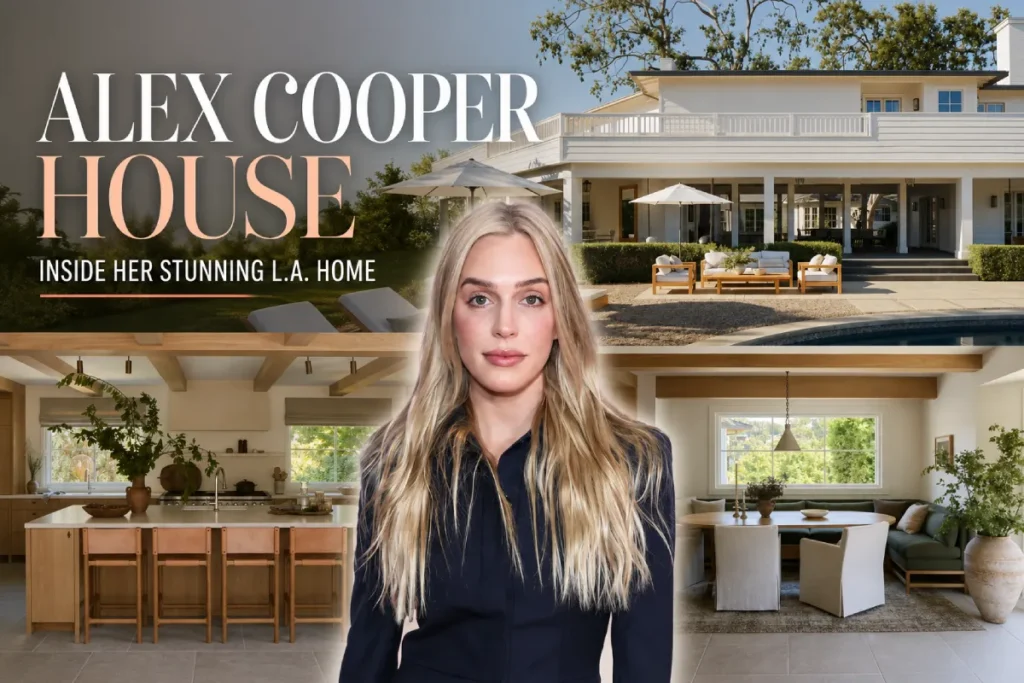
Alex Cooper House, the stunning Studio City estate of podcast mogul Alex Cooper, blends 1930s Colonial Revival architecture with a deeply personal renovation by the Call Her Daddy host and her husband, Matt Kaplan. Cooper and Kaplan paid $10.7 million for the property in 2022. Since then, they’ve transformed a dated compound into a warm, nature-inspired retreat that reflects both Hollywood’s golden-era charm and their own modern taste.
Alex Cooper House is more than a celebrity address. It’s a case study in how a thoughtful renovation can breathe new life into historic real estate. From the limestone floors to a favorite walk-in closet, every room tells a story of deliberate design choices — plus one very relatable furnishing struggle familiar to anyone who has tried to make a Pinterest board look this good in real life.
Where does Alex Cooper currently live?
The estate sits behind gates on roughly 1.5 acres in Studio City, California. It’s a late-1930s Colonial Revival ranch that spans two separate parcels of land. The main residence covers approximately 5,300 square feet. A separate guesthouse adds another 1,600 square feet, bringing the total to nearly 6,900 square feet of combined living space. No reliable source has confirmed exact bedroom or bathroom counts for the full property, so we’re leaving that figure out rather than guess.
Alex Cooper, host of “Call Her Daddy,” owns the property with her husband, producer Matt Kaplan, founder and CEO of Ace Entertainment. County transaction records show the couple bought the home on June 14, 2022, from seller Alba di Angeli. They’ve since completed a full renovation, working with interior designer Lindsay Balton of Balton Design to reimagine every room.
This residence stands out beyond its price tag and celebrity ownership. It sits at the intersection of Los Angeles architectural history, the booming creator economy, and the growing appeal of heritage real estate in Southern California.
Historical Significance of the Estate
Builders finished the home in the late 1930s, during a period of explosive growth in Los Angeles. As the entertainment industry expanded westward through the 1920s and ’30s, neighborhoods like Studio City shifted from rural outposts into affluent suburban enclaves built for the film industry’s rising professional class. That shift gave the area its name, thanks to the nearby studio lots.
Colonial Revival was one of the most popular residential styles of that era. The style drew on America’s 18th-century architectural traditions and favored symmetry, proportion, and restrained elegance over the ornate excess of earlier Victorian designs. Cooper and Kaplan’s home reflects that ethos through its balanced facade, multi-pane windows, and columned entryway.
The property is one of the few surviving estates from this period of Studio City’s development. Many of its contemporaries have since been demolished or heavily altered, which makes this a relatively rare example of intact pre-war residential architecture in the San Fernando Valley.
Architectural Features
The exterior presents a classic Colonial Revival profile: a symmetrical facade, columns flanking the main entrance, and rows of multi-pane windows that flood the interior with natural light. These elements create a sense of formality that softens as you move deeper into the property.
The grounds are where the estate distinguishes itself most. A wisteria-covered archway leads to an outdoor courtyard that serves as a central gathering point, bridging the home’s formal architecture with the relaxed indoor-outdoor lifestyle of Southern California. The courtyard also holds personal significance. Kaplan proposed to Cooper here in March 2023. He staged a fake magazine photoshoot to get her out of the house, then filled it with candles and set up a scavenger hunt that ended with her finding him by a Buddha statue in the courtyard. A swimming pool anchors the rear landscape, and the nearly 1.5-acre lot gives the property an unusually secluded, pastoral feel for its location.
The grounds also include a vegetable garden and a chicken coop. These details reinforce the property’s wellness-oriented atmosphere and give the estate a working, lived-in quality beyond pure luxury staging. A gated entrance keeps the street at a distance while preserving that open, pastoral feel.
The Renovation: From Dated to Distinctive
When Cooper and Kaplan first saw the property, its interiors told a different story. Years of piecemeal renovations by prior owners had left the home filled with what Architectural Digest described as faux brick, vinyl tufting, and other synthetic materials. The bones of a great house were there, but the finishes had drifted far from the couple’s taste.
“I was a little overwhelmed by how much of an undertaking it would be, because it was not our style whatsoever,” Cooper told the publication. “It was so far from our taste that it allowed us to tailor every single room to our liking.”
The couple hired Lindsay Balton of Balton Design to lead the transformation, a process that took just over a year. The renovation stripped away the synthetic layers and replaced them with natural materials chosen for warmth and texture: aged oak, limestone, and patinaed metals. Balton’s team emphasized the home’s large windows rather than covering them, letting natural sunlight define the interior atmosphere.
Cooper has described the finished home as “our sanctuary” — a deliberate counterpoint to two demanding careers. A neutral, calming color palette runs throughout, grounding the spaces without competing with the greenery visible from nearly every window. Soft textures fill the bedrooms and living areas: blankets, plush upholstery, natural fibers. They invite you to settle in rather than admire from a distance.
That combination of refined materials and unpretentious comfort defines the renovation’s success. This is a home built to be lived in, not just photographed.
Interior Design & Personal Touches
The interiors carry real personal meaning for the couple, beyond the finishes themselves. Cooper has singled out her closet as her favorite room in the house. “My favorite place on earth,” she called it in her interview with Architectural Digest, adding that Kaplan jokes she never seems to leave it. She’s also talked about handing much of the renovation’s creative direction to Kaplan, telling AD that his taste guided many of the couple’s choices.
The Bar
The bar counts among the home’s most personal spaces. “[Matt and I] fell in love in London drinking whiskey together, so we always said we needed to recreate a dark bar with whiskey,” Cooper said. She described it as having a different feel from the rest of the home — “like we’re going out on a date night, [but] we’re just going out to our bar together.”
Kitchen
The kitchen carries its own sentimental weight. It served as one of the stops on the scavenger hunt Kaplan built for Cooper’s proposal, decorated that night with framed photos marking milestones in their relationship.
Outside
Outside, the vegetable garden and chicken coop reflect a lifestyle goal that goes beyond luxury finishes. Cooper has described wanting the property to function like a wellness retreat, a place where the pace slows down and the surroundings encourage calm. The meadowy landscaping, the wisteria archway, and the pool all support that vision.
These details point to something important about the renovation. It wasn’t only about updating finishes. Cooper and Kaplan built a space that reflects who they actually are — their routines, their taste, their relationship — rather than chasing a trend.
A Smart Real Estate Play
Beyond its architectural appeal, the estate carries real financial logic. The $10.7 million purchase price positions the property well within the trajectory of Los Angeles’ high-end real estate market.
Several factors support that read. The two-parcel structure offers built-in flexibility, since the main house and guesthouse sit on separate lots. That opens options for future redevelopment, expansion, or independent sale down the line — a relatively rare advantage for a single-family estate.
Demand for intact 1930s properties in desirable Los Angeles neighborhoods keeps growing, as new construction increasingly dominates the luxury market and authentic period details become harder to replicate. The renovation itself has likely added real value, too. By replacing dated, synthetic finishes with high-end natural materials and reconfiguring the interior for modern living, Cooper and Kaplan boosted both the functionality and the marketability of the property without sacrificing its historic character.
Cooper’s Growing Financial Footprint
Cooper’s financial trajectory helps explain how the couple can invest in a property like this for the long term. Her podcasting career built serious wealth on its own: a three-year, $60 million deal with Spotify came first, followed in 2024 by a reported multiyear SiriusXM agreement worth more than $100 million.
Around the time they got engaged in 2023, Cooper and Kaplan also co-founded Trending, a Gen Z-focused media company. Trending now serves as the parent company for Call Her Daddy’s Unwell Network and Kaplan’s Ace Entertainment, and the venture recently landed its first outside investment at a $500 million valuation. That financial foundation lets the couple invest in the Studio City property for the long haul, rather than face pressure to flip it.
Did Alex Cooper Buy her Parents a House?
Cooper’s decision to buy her parents, Bryan and Laurie, a home of their own in Los Angeles after the SiriusXM deal closed further illustrates her approach to real estate: personal first, financial second. Her parents relocated from Newtown, Pennsylvania, to be closer to their daughter, a move Cooper described as deeply emotional on a Christmas episode of her podcast. The move also closed a chapter for the family, since their longtime Newtown home sold in May 2025.
Conclusion
No single feature makes this estate remarkable. It’s how everything comes together: a rare 1930s Colonial Revival shell, a meticulous renovation guided by natural materials and personal history, and an owner whose career trajectory suggests the property will keep evolving alongside her.
For Alex Cooper and Matt Kaplan, the home has become the backdrop for some of their biggest personal milestones — their engagement, and the years since spent building both a marriage and a media company together. For the Los Angeles real estate market, the estate is a reminder that heritage properties, when thoughtfully updated, can hold their own against the most expensive new builds in the city.
The blend of historical character, modern comfort, and genuine personal investment makes this a standout among Los Angeles’ famous addresses. As Cooper herself might put it, the house was never meant to look like the Pinterest board. That’s exactly the point.
