

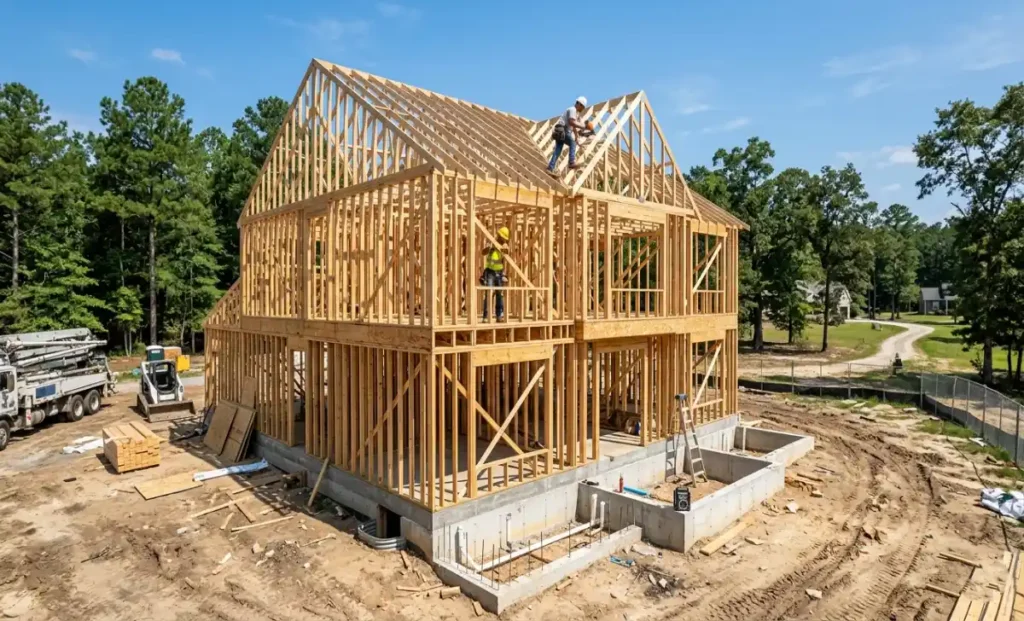
A stick-built home is a house constructed on-site, piece by piece, using wood framing. Builders erect the entire structure at the location where you will live, from the foundation up. With stick-built construction, you call the shots—choose your floor plan, pick every finish, and tweak details as the build unfolds. It typically costs between $150 and $300 per square foot in 2026, depending on location, complexity, and material choices.
Did you know that stick-built home construction accounts for roughly 90% of all single-family homes built in the United States? If you are planning to build a home, you will likely encounter this method first. But what does it actually involve, what does it cost, and how does it compare to alternatives like modular construction?
This guide answers those questions directly so you can make a clear, informed decision.
What a Stick-Built Home Actually Is
A stick-built home is built on your land, from scratch, using individual pieces of lumber. Builders assemble walls, floors, and roof structures directly on-site. The term “stick-built” comes from the process of framing a house stick by stick using dimensional lumber such as 2x4s and 2x6s.
This is different from homes that arrive in sections from a factory. With stick-built construction, every structural decision happens at your site, in real time. That gives builders the ability to adjust, modify, and customize as the work progresses.
Stick-built homes are also called “site-built” or “conventionally built” homes. All three terms refer to the same construction method.
How the Stick Built Construction Process Works
The process follows a clear sequence. Understanding it helps you track progress and ask the right questions at each stage.
Here’s your stick-built home journey—from clearing the lot to turning the key:
- Site preparation and foundation: The lot is cleared, graded, and a concrete foundation is poured.
- Framing: Builders erect the floor system, stud walls, and roof trusses using lumber.
- Rough-ins: Electrical wiring, plumbing pipes, and HVAC ductwork are installed inside the walls before they close.
- Insulation and drywall: Once inspections pass, insulation goes in, and drywall is hung and finished.
- Interior finishes: Flooring, cabinets, countertops, trim, and fixtures are installed.
- Exterior work: Siding, roofing, windows, and doors are completed throughout the build.
- Final inspections: Local building officials verify the home meets code before occupancy is approved.
Most stick-built homes take 6–12 months from groundbreaking to move-in, but your timeline depends on three things: your local permit speed, builder schedule, and how cooperative the weather is.Stick-Built Home Costs in 2026
Costs vary—but here’s the realistic 2026 range most buyers actually pay, plus the key factors that push your price up or down.
According to 2026 RSMeans Data, stick-built construction averages $150–$300 per square foot for labor and materials, with lower-cost regions like the Southeast trending near $150/sq ft, while high-demand markets like California or the Northeast often exceed $250/sq ft. A 2,000-square-foot home could therefore range from $300,000 to $600,000 before land, permits, and site preparation.
Per NAHB cost breakdown standards, finishes and structural complexity drive the largest variances in stick-built budgets. Factors that push costs higher include:
- High-end finishes (hardwood, stone, custom cabinetry) can add 20–40% to base costs
- Complex roof designs with multiple pitches or dormers increase framing labor by 15–25%
- Cathedral or vaulted ceilings above nine feet
- Unusual lot conditions (slope, poor soil) may require $10K–$50K in extra site work
- Locations with high labor costs or material shortages
Factors that can reduce costs include simple rectangular floor plans, standard ceiling heights, and building in areas where contractor competition keeps labor rates reasonable.
You should also budget a contingency fund of 10 to 15 percent of your total construction cost. Unexpected issues, such as poor soil conditions or design changes mid-build, are common on site-built projects.
Stick Built vs. Modular Homes
This comparison comes up often, and the differences are more significant than most people realize.
A modular home is built in climate-controlled sections inside a factory. Those sections are transported to your land and assembled on a foundation. Modular homes are typically faster to build and can cost less per square foot, but your design options are limited by whatever configurations the manufacturer offers.
A stick-built home is built entirely on your land. You are not constrained by factory module sizes or shapes. If you want a curved interior wall, a sunken living room, radiant floor heating, or a custom roofline, stick-built construction makes all of that possible. Modular construction generally does not.
Here is a direct comparison of key differences:
| Feature | Stick Built | Modular |
|---|---|---|
| Where it is built | On your land | In a factory |
| Design flexibility | Very high | Moderate |
| Build timeline | 6 to 12 months | 3 to 6 months |
| Cost per square foot | $150 to $300+ | $100 to $200+ |
| Weather exposure during build | Yes | Minimal |
| Resale value | Strong | Generally comparable |
| Financing | Standard mortgage | Same as stick-built |
Manufactured homes are a separate category. They are built to a different federal code (HUD standards rather than local building codes) and are designed to be transported to a site, not permanently built on a foundation in the same way. They tend to cost less but may depreciate over time rather than appreciate.
Pros and Cons Worth Knowing
Every construction method has trade-offs. Here is a clear look at both sides.
Advantages of a Stick-Built Home:
- Full design flexibility, including unusual layouts, ceiling heights, and structural features
- Built to comply with the International Residential Code (IRC) and local amendments, ensuring structural safety, energy efficiency upgrades, and seamless mortgage eligibility
- Easier to customize mid-build if your plans change
- Allows for high-performance insulation, air sealing, and energy upgrades built into the structure—like targeting Energy Star Certified Homes standards or a low RESNET HERS Index score
- Strong long-term appreciation potential since you own both the land and the structure
Disadvantages of a Stick-Built Home:
- Higher upfront cost compared to modular or manufactured options
- Longer build time, typically six months or more
- Exposure to weather delays during framing, roofing, and exterior work
- Requires careful contractor vetting since quality varies significantly between builders
- More complex project management than buying a finished home
One underappreciated downside: quality control varies widely between stick-built builders. Unlike a factory environment where processes are standardized, site-built homes depend heavily on the skill and attention of individual crews. Because every stick-built home is custom, your builder’s skill makes or breaks the result—so vetting isn’t optional, it’s your #1 priority.
When a Stick-Built Home Makes Sense for You
Stick-built construction is the right call in specific situations. It is not automatically the best choice for everyone.
You should seriously consider stick-built construction if:
- You want a highly customized design that no factory can replicate
- Your lot has unusual terrain, access limitations, or setback requirements that make modular delivery impractical
- You plan to include complex structural features such as large overhangs, irregular rooflines, or specialty ceiling systems.
- You want full control over the materials used throughout the build
- You are building for the long term and prioritizing resale value and mortgage financing flexibility
On the other hand, if speed and lower upfront cost matter most, and you can work within standard floor plan configurations, modular construction may serve you better.
The right choice depends on your priorities. Be specific about what you want before you compare quotes.
How to Choose aStick-Builtt Home Builder
Your builder is the single biggest variable in a stick-built project. Here is what to look for.
Ask every builder you interview these questions:
- How many stick-built homes have you completed in the last three years?
- Do you use your own framing crew, or do you subcontract it?
- How do you handle weather delays and schedule changes?
- Can I visit one of your current or recently completed projects?
- What warranty do you offer on materials and workmanship?
A builder who owns their own framing crew typically provides better schedule control and quality consistency than one who subcontracts everything. Ask to see recent projects in person, not just photos. Talk to previous clients if you can.
Get at least three detailed bids. Compare them line by line, not just the total. A low bid that excludes key items will end up costing more than a higher bid that includes everything.
FAQs
Is a stick-built home the same as a frame house?
Yes—both terms describe wood-frame construction built on-site. You’ll also hear ‘stick frame’ or ‘conventionally built,’ all referring to the same method using dimensional lumber like 2x4s.
Do stick-built homes hold their value?
Yes, in most markets, they appreciate over time. Since they are built to local building codes and sit on a permanent foundation, they qualify for standard mortgage financing and typically follow local real estate market trends.
Is a stick-built home stronger than a modular home?
Both are built to meet structural standards, but they follow different code paths. Stick-built homes comply with local building codes enforced by on-site inspectors. Modular homes meet state-level standards set in the factory. Neither is automatically stronger; quality depends on the builder and materials used.
How long does it take to build a stick-built home?
Most projects take between six and twelve months from breaking ground to move-in. Permits, weather, contractor availability, and design complexity all affect the timeline.
Can I get a mortgage for a stick-built home?
Yes. Stick-built homes qualify for all standard mortgage products, including conventional, FHA, VA, and USDA loans. During construction, you would typically use a construction-to-permanent loan, which covers the build phase with interest-only payments and automatically converts to a traditional mortgage once you receive your certificate of occupancy.
