

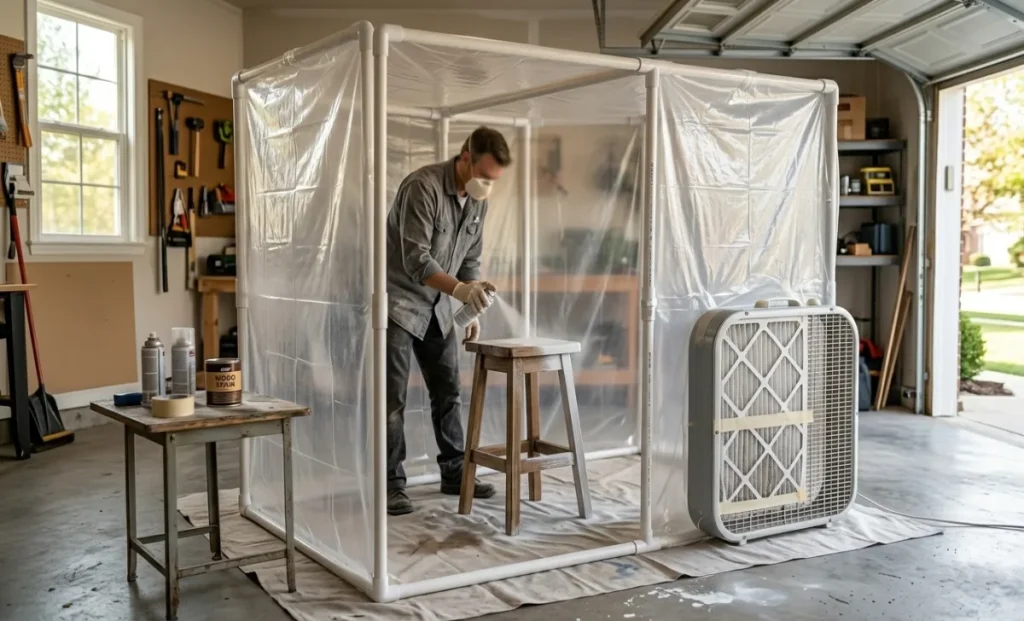
A DIY paint booth gives you a contained space to spray paint furniture, car parts, or small projects without coating your entire garage in overspray. You can build a basic version with PVC pipe, plastic sheeting, a box fan, and HVAC filters for under $60. A more permanent setup with ducting and a blower motor runs $200 to $500 but handles larger projects and keeps fumes out of your living space.
The three most common setups are a plastic sheeting enclosure, a freestanding PVC frame with filtered exhaust, and a built booth with exterior ducting. Your choice depends on what you paint, how often you paint, and how much space you have. Regardless of the route you take, ventilation and lighting are the two variables that separate a finish that looks professional from one that goes back through the booth.
Why You Need a Paint Booth Before You Spray
Spray painting without an enclosure sends paint particles everywhere. A single can of aerosol lacquer creates an airborne mist that travels several feet beyond your target. That mist settles on your car, your tools, and every surface it touches.
Beyond the mess, paint fumes contain solvents like xylene, toluene, and acetone. Breathing those in a closed garage without ventilation causes dizziness, nausea, and long-term respiratory damage. A booth contains the mess and, when ventilated correctly, keeps the air around you breathable.
Finish quality goes up, too. Dust, bugs, and airborne debris land on wet paint constantly in an open garage. A sealed enclosure cuts that contamination significantly and gives you a controlled environment where you can actually see what you’re spraying.
Three DIY Paint Booth Types and What Each Costs
Your setup choice comes down to project size and how often you spray.
A plastic sheeting booth costs $30 to $60. You tape 3-4 mil poly sheeting to your garage ceiling and walls, lay a drop cloth on the floor, and position a box fan with a basic HVAC filter at one end. This works for furniture, cabinet doors, and smaller automotive parts. The booth breaks down in minutes and stores in a single bin. The downside is that thin plastic diffuses overhead lighting badly, and the filter capacity is low, so you replace filters often during longer sessions.
A PVC frame booth runs $80 to $150. You cut 3/4-inch PVC pipe to length, connect corners with 90-degree elbows, and drape plastic sheeting over the structure. The result is a freestanding enclosure that doesn’t require taping to your ceiling and holds its shape throughout a session. One builder documented building a 7-foot cube version of this for under $100, including the fan and filters, with enough headroom to spray tall pieces of furniture.
A built booth with ducted ventilation costs $200 to $500, depending on materials. This involves 2×4 framing, white coroplast or sheet metal panels, and a belt-driven furnace blower with 6-inch metal ducting vented through an exterior wall. This type handles large projects, contains catalyzed paint fumes properly, and keeps your garage breathable session after session. The belt-driven motor matters because it sits outside the airflow path. A standard fan motor inside the exhaust stream creates a spark risk when flammable vapors are present.
Materials for a Basic DIY Spray Paint Booth
For a PVC frame setup, here’s what you need:
- 12 sections of 3/4-inch PVC pipe cut to 7 feet each
- 8 three-quarter-inch 90-degree side-out elbows
- One 10-pack of 3-4 mil plastic drop cloths
- One 20-inch box fan
- Two 20×20-inch basic HVAC filters
- Painter’s tape and a second, heavier drop cloth for the floor
Skip the premium HVAC filters. Paint particles are large enough that a standard MERV 4-6 filter captures them. Save the money and buy extra replacement filters instead, because you’ll go through them faster than you expect.
Ventilation: The Part Most DIY Booths Get Wrong
Most first-time builders focus entirely on the frame and ignore airflow. That’s where real problems start.
Paint fumes, especially from catalyzed coatings and lacquers, build up fast in a sealed space. These fumes contain solvents like xylene, toluene, and acetone that cause dizziness, nausea, headaches, and long-term respiratory damage when inhaled in a closed garage. A box fan with a basic filter reduces overspray but does not fully address fumes.
For a temporary setup, position the fan at one end with the filter facing inward and run the exhaust toward an open door or window. For anything permanent, duct the exhaust outside. As a general benchmark, aim for 100 to 150 cubic feet per minute per square foot of floor area. A 10×10-foot booth needs a system rated for at least 10,000 CFM to move air at that rate. For a small hobby booth, you won’t hit those numbers, but the principle holds: the booth needs to move more air than the spray puts into it.
One detail most builders miss is the intake side. If you only exhaust air without replacing it, you create negative pressure that pulls dusty garage air in through every gap in your sheeting. Add a filtered intake on the opposite end from your exhaust. A 20×20 HVAC filter taped over a cut opening works fine. Air enters clean, travels across the project, picks up overspray, and exits through the exhaust filter.
NFPA 33 also requires at least 3 feet of clearance between any spray area and stored combustible materials. Move your gas cans, rags, and paint thinner before you start.
Lighting and Workflow Inside the Booth
Kyle Smith of Hagerty ran into this directly when setting up a home paint booth for a motorcycle project. His well-lit garage became poorly lit the moment he stepped inside a plastic sheeting enclosure. The plastic diffused the overhead light enough to make coverage inspection difficult. His workaround was holding an LED flashlight in his off hand while spraying, though he noted floor-mounted LED shop lights on stands solve the problem more reliably.
Two shop lights inside the booth at floor level, pointed upward at your piece, eliminate most shadows. Position one on each side of the object you’re spraying. You’ll catch thin spots, runs, and uneven coverage before the paint dries.
Plan your sequence before you pick up the gun. If you use a spray gun with catalyzed paint, the clock starts when you mix. A 2K urethane clearcoat may give you 20 to 30 minutes of pot life. Spray inner faces first, then outer faces, then a final pass across all surfaces. If you stop mid-job to find a clean rag or figure out where to hang a part, the material starts to set, and your coats become uneven.
Four Mistakes That Ruin the Finish
Skipping the floor covering costs you the finish. Dust from concrete floors kicks up the moment you walk around inside the booth. Wet the floor before you enter, or lay drop cloths. One pass across dry concrete while the paint is wet ruins the piece.
Using a standard box fan motor for permanent exhaust creates a spark risk when flammable vapor is present. Belt-driven blowers with motors mounted outside the airstream are the correct choice for anything beyond rattle cans or water-based paints.
Not replacing filters on schedule reduces airflow, raises fume concentration, and pushes back pressure that forces overspray out of gaps in the booth walls. Replace paint booth filters every 20 to 30 hours of use, depending on paint type and frequency.
Painting in the wrong conditions undoes all the prep. Cold temperatures slow curing and create a fisheye in solvent-based paints. High humidity causes lacquers to blush, leaving a milky haze in the finish. The sweet spot for most spray applications is 60 to 80 degrees Fahrenheit at below 50 percent relative humidity.
FAQs
Can I use a DIY paint booth for full car panels?
Yes, but you need enough interior space. A 7-foot cube handles fenders and doors. Full bumpers and hoods require at least an 8×10-foot enclosure. Full-car spraying requires a permanent built structure with proper ducting and significantly more airflow.
Do I need a respirator even with good ventilation?
Always. Ventilation reduces fume concentration but doesn’t eliminate it. For rattle cans, an N95 is the minimum. For spray guns and catalyzed coatings, use a half-mask respirator with organic vapor cartridges, or a supplied-air respirator for longer sessions.
How long does a plastic sheeting booth last?
A single build lasts several sessions if you’re careful. Paint particles eventually clog the plastic and cause light contamination. Replace the sheeting when you see buildup or when overspray starts migrating past the enclosure walls.
What’s the least expensive way to start?
Tape plastic sheeting to your garage ceiling and walls, lay a drop cloth on the floor, and place a box fan with a 20×20 HVAC filter at one end. Total cost runs $30 to $50 and works well for furniture and small parts, though not for automotive spray gun work, where fume control matters more.
Can I spray inside a closed garage without a booth?
Only with the garage door fully open and cross-ventilation from a second opening. Even then, overspray settles on everything in the space, and fume concentration builds fast. A booth, even a basic plastic one, is the better option every time.
