

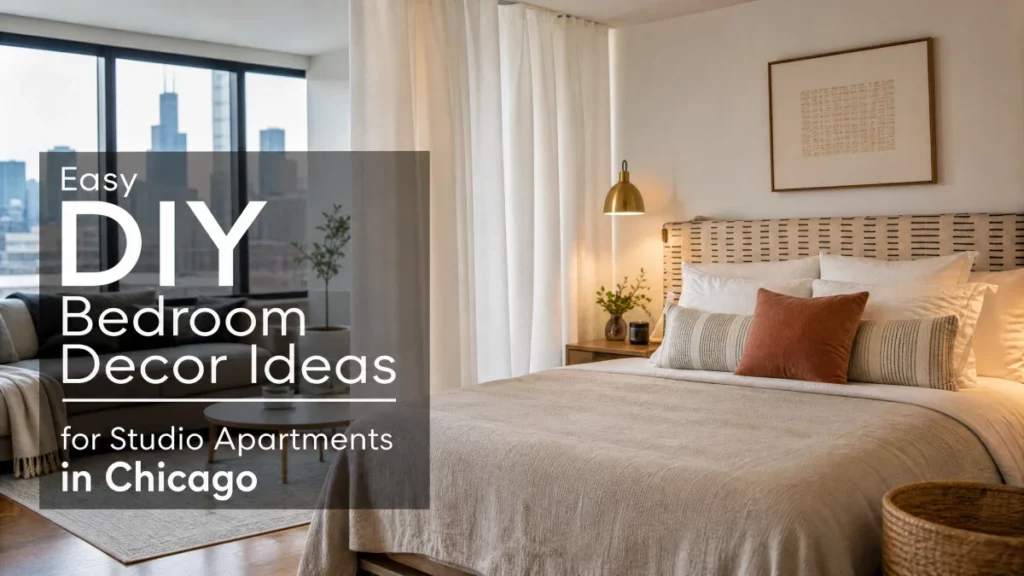
My client Maya rented a 450-square-foot studio in Wicker Park and called me frustrated. She had one main room that was supposed to be her living room, bedroom, dining area, and home office simultaneously. Her landlord wouldn’t allow wall anchors without written permission. Her building had radiator heat that took up floor space. And her budget was $300.
Six weeks later, her apartment looked intentional. Not like a compromise.
That’s the real challenge with studio apartments in Chicago: it’s not just about making a small space look nice. It’s about making a single room function as a bedroom without turning it into a storage unit that you happen to sleep in. This article covers the specific DIY projects that actually move the needle in Chicago studio setups: the ones that work with older building restrictions, Chicago’s seasonal temperature swings, and realistic budgets under $500.
Understanding DIY Bedroom Decor for Studio Apartments in Chicago
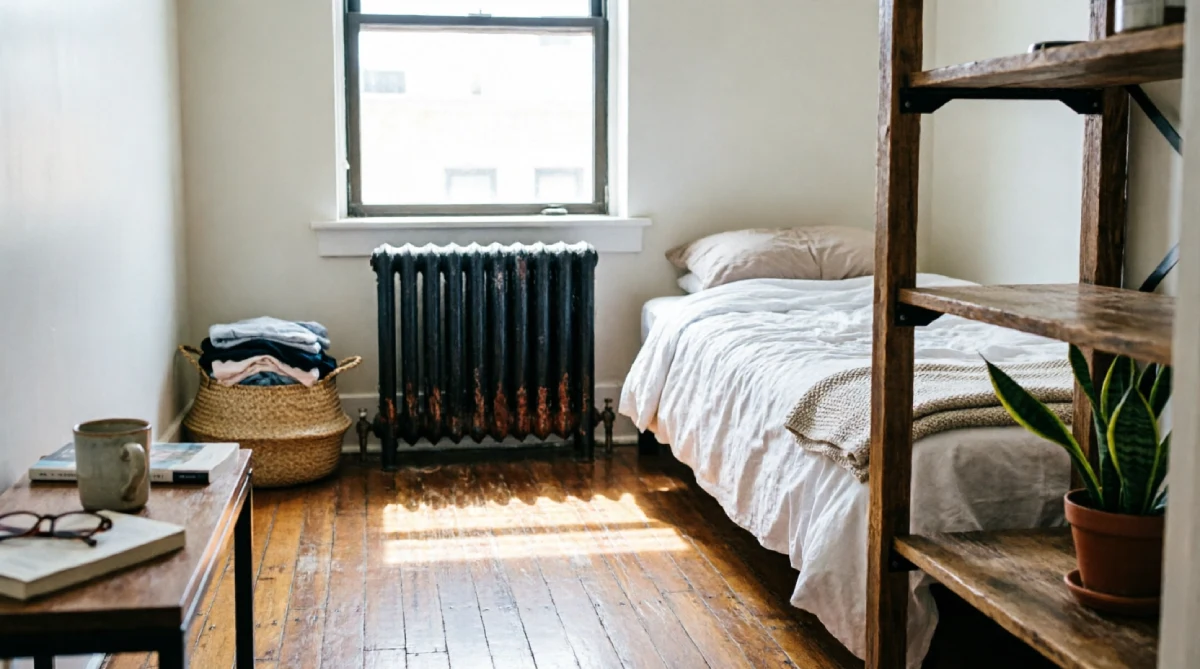
Chicago studio apartments come with constraints you don’t face in newer builds in warmer cities. Most of the rental stock in neighborhoods like Logan Square, Pilsen, Lincoln Park, and Andersonville dates from the 1920s through the 1960s. That means:
- Radiators — cast-iron units that stick out from walls and generate uneven heat
- Low ceilings — typically 8 to 9 feet, rarely more
- Original hardwood floors — often beautiful but sometimes damaged, and landlords want them protected
- Older electrical — limited outlet placement, sometimes no overhead lighting in the “bedroom” area
- Strict lease terms — many Chicago landlords (especially in greystone buildings) prohibit nails larger than a 10-penny nail, anchor bolts, or wall patches without approval
Any DIY bedroom decor plan for a Chicago studio has to account for all of this upfront. The projects that work best here are ones that:
- Don’t require wall anchors (or use command strips rated for the load)
- Add vertical interest without eating floor space
- Create a visual and psychological separation between the sleeping area and the living area
- Work in rooms that get cold near windows from November through March
The biggest mistake I see Chicago studio renters make is spending money on decor before solving the layout. A beautiful throw blanket on a poorly positioned bed doesn’t fix the fact that the bed dominates the room. Start with the zone, then decorate it.
Zone first, decorate second. That’s the principle that drives everything below.
Best DIY Approaches to Bedroom Decor in a Chicago Studio
1. Use a Room Divider to Define the Sleeping Zone
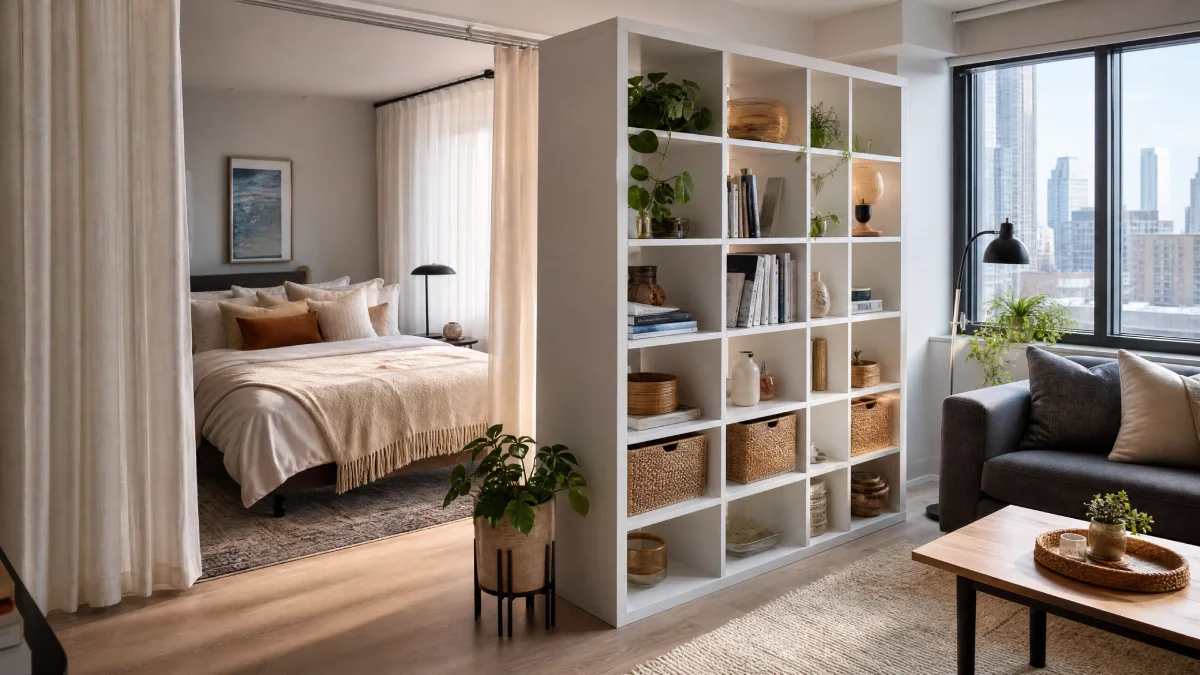
In a Chicago studio, the bedroom isn’t a room — it’s a zone you create. A freestanding room divider is the single highest-impact DIY addition you can make. You’re not building walls; you’re creating visual separation that signals “this is where I sleep.”
DIY options that work:
- Tension rod curtain divider — Install two ceiling-height tension rods parallel to each other, hang floor-length curtains, and you’ve created a soft partition. Use blackout curtains ($25–$45 at IKEA Clybourn on N. Clybourn Ave.) to block light and create genuine sleeping-zone darkness even if you’re watching TV 10 feet away.
- IKEA Kallax shelf divider — A 4×2 or 4×4 Kallax unit costs $80–$160 and acts as a freestanding room divider with built-in storage. You face the open side toward the bedroom zone for storage access; the solid back faces the living area. No wall anchors required. Add anti-tip furniture straps ($8) to anchor it to a baseboard.
- Macramé or fabric panel from a dowel rod — A DIY woven panel hung from a ceiling-mounted curtain track (command-strip mounted, no drilling) adds texture and definition for under $40 in supplies.
What to avoid: Bookshelves that are too short (anything under 5 feet doesn’t create meaningful separation) and folding screens that wobble or tip easily.
2. Build a Faux Headboard Without Touching the Wall
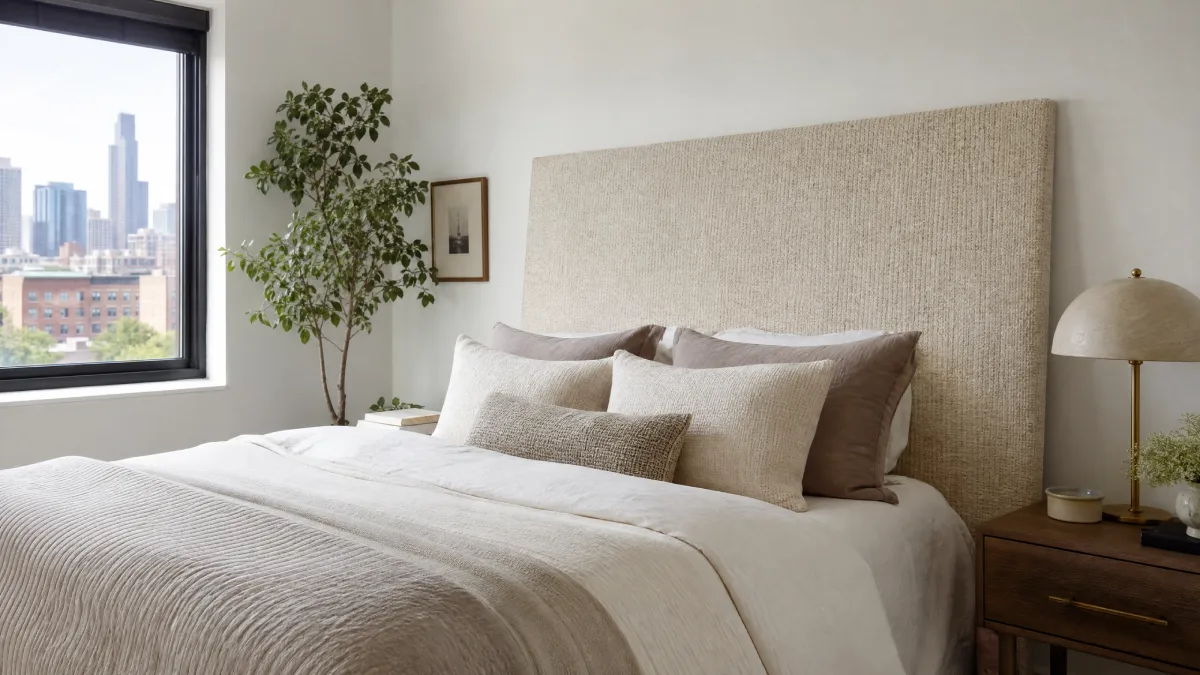
Most Chicago rental leases prohibit mounting anything heavy on the walls without written approval. A faux headboard solves this while making the sleeping zone feel finished.
DIY options:
- Fabric panel headboard — Buy a 36″x48″ piece of foam (1.5-inch density from Joann Fabrics on N. Elston Ave.), wrap it in your fabric of choice, and staple the back. Lean it against the wall. Cost: $30–$55 total.
- Shiplap-style plywood panel — Cut a 4×8 sheet of 1/4-inch plywood into 6-inch strips, paint or stain them, and construct a panel that simply leans against the wall behind the bed. Cost: $35–$60 in materials.
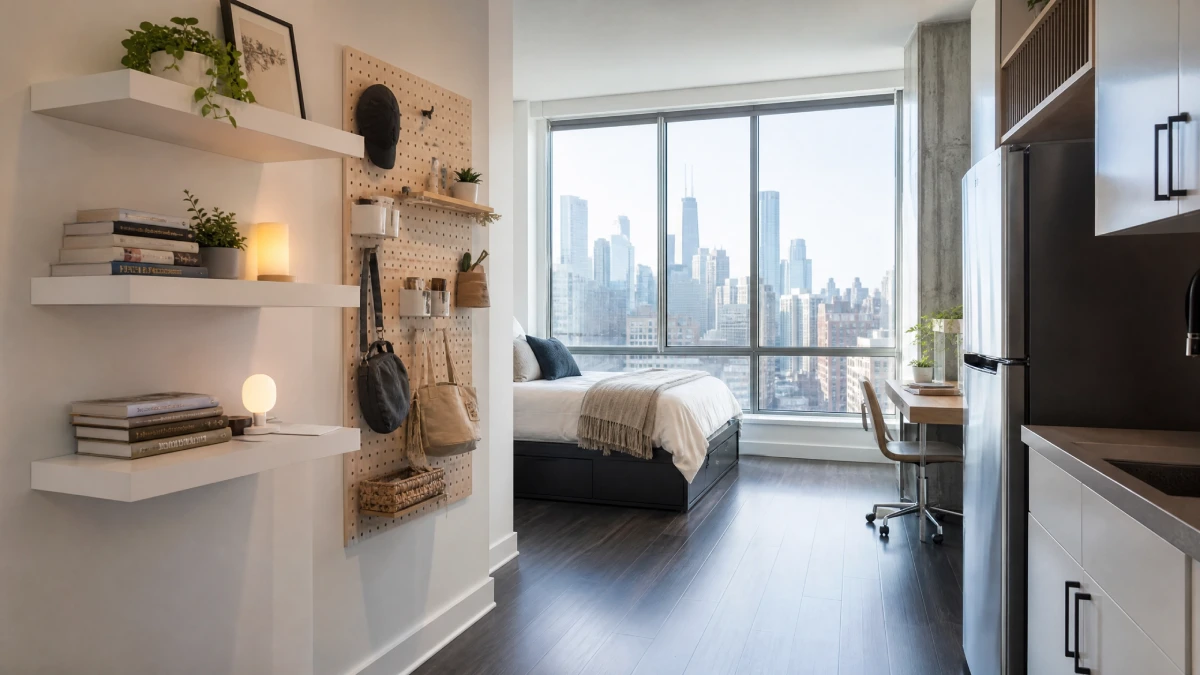
- Pegboard headboard with storage — A 48″x32″ pegboard (Home Depot in Chicago carries them for about $22) painted in a matte color and leaned against the wall, gives you a headboard with hooks for phone chargers, a small lamp, and accessories. No drilling required.
The key in any Chicago apartment: lean, don’t mount. If your landlord has approved anchors, a French cleat system (two interlocking angled strips screwed to the wall) is the cleanest way to hang a headboard panel securely without visible hardware.
3. Add Vertical Storage to Keep the Floor Clear
Floor space is the most valuable asset in a Chicago studio. Every piece of furniture that sits on the floor competes with your ability to move through the room. The fix is vertical storage — shelving, hooks, and over-door organizers that use wall and door surfaces instead.
DIY vertical storage projects:
- Floating shelf stack — Use IKEA Lack shelves ($10–$14 each) with command strips rated for 16 lbs per strip. Stack three on the wall beside your bed for books, plants, and a lamp. Cost: $35–$50 for three shelves with hardware.
- Over-door organizer for the closet door — Most Chicago studio closets are shallow with a single bar. Add an over-door shoe organizer (repurposed for accessories, chargers, and small items) from Target or Amazon for $15–$25.
- Pegboard wall panel for the bedroom zone — Same pegboard concept from the headboard section can be used on a side wall to hold accessories, small baskets, and hooks. A 4×4 pegboard panel with hooks and baskets runs about $35–$55 total.
4. Control Light Without Blocking the Windows
Chicago apartments in older buildings often have one or two windows in the main room. Those windows are your primary source of natural light, and blocking them hurts the space. The goal is to control the light — filter it, diffuse it, or block it in the sleeping zone specifically, without killing it everywhere.
DIY solutions:
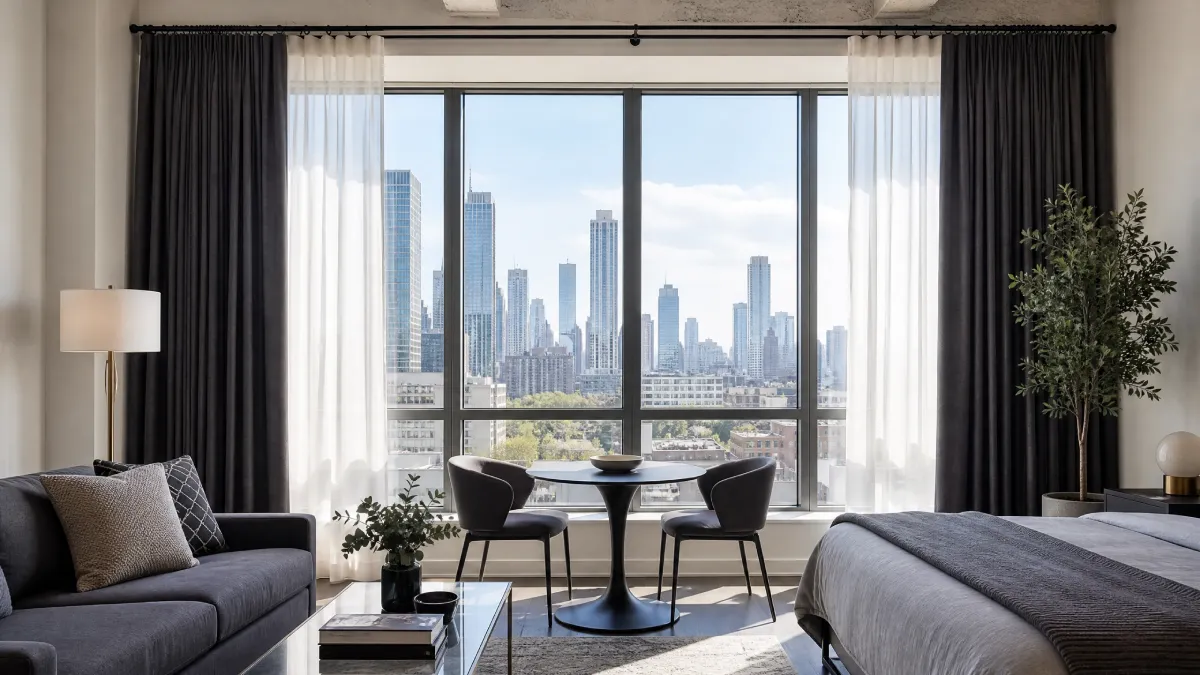
- Double curtain rod setup — Use an expandable double curtain rod ($20–$30 at Home Depot) to hang sheer curtains on the inside rod (for diffused daytime light) and blackout curtains on the outer rod (for sleeping). This gives you two independent light settings with one hardware install.
- Window film — Frosted or decorative window film ($12–$20 per sheet at Lowe’s on W. Grand Ave.) applies directly to glass with water. It filters light, adds privacy, and peels off cleanly when you move out. Chicago landlords cannot object to this — it leaves no damage.
- String light canopy — For the bedroom zone, clip string lights to the ceiling using command hooks and drape them in a canopy pattern over the bed. It creates ambient light separate from the overhead room fixture, which matters in studios where the single overhead light is often in the center of the room, not near the bed. Cost: $15–$30 for 33-foot string lights from Home Depot.
Cost Breakdown: DIY Bedroom Decor for Chicago Studio Apartments
| Project Category | Low Budget | Mid Budget | High Budget |
|---|---|---|---|
| Zone divider (curtain or shelf) | $25–$45 | $80–$130 | $150–$220 |
| Faux headboard | $25–$40 | $45–$75 | $80–$120 |
| Vertical storage (3 shelves + hooks) | $30–$50 | $60–$90 | $100–$160 |
| Lighting (string lights + curtains) | $25–$45 | $55–$90 | $100–$160 |
| Bedding and textile layering | $40–$70 | $80–$140 | $160–$280 |
| Total estimated range | $145–$250 | $320–$525 | $590–$940 |
Chicago-specific cost notes:
- IKEA Clybourn (600 N. Clybourn Ave.) is the go-to for low-budget furniture and storage. Most Kallax and Lack products are in stock and available same day.
- Home Depot locations in Halsted and Grand Ave. stock pegboard, plywood, and curtain hardware year-round.
- Menards (closest to Chicago proper: Cicero Ave. location) is cheaper than Home Depot on raw materials like plywood, foam board, and paint. Worth the trip if you’re doing a larger project.
- Chicago thrift stores — Unique Thrift (multiple locations), Village Discount, and Brown Elephant — regularly stock frames, baskets, and textiles for $2–$15 that can be repurposed into bedroom decor.
- Labor, if you hire a handyperson to help with assembly or light installation, runs $60–$90/hour in Chicago’s urban neighborhoods. Most of these projects are genuinely doable solo in 2–4 hours.
Common Mistakes Studio Apartment Renters Make in Chicago
Most of these I’ve seen in real projects across Lakeview, West Loop, and Pilsen. They’re fixable, but they cost time and money to undo.
- Buying furniture before measuring. A standard queen bed frame is 60″x80″. Many Chicago studio apartments have main rooms that are only 12 feet wide. A queen bed plus a nightstand plus a dresser can consume 60–70% of the floor. Measure twice, buy once.
- Ignoring the radiator. Chicago’s cast iron radiators typically sit under windows and stick out 8–10 inches from the wall. Furniture placed too close to radiators is a fire hazard and damages the pieces from the heat. Design around the radiator, not as if it doesn’t exist.
- Using dark paint without landlord approval. Some Chicago landlords will allow an accent wall, but most expect white or off-white walls upon move-out. If you paint without permission, you’re paying for a repaint ($150–$300 for a studio) when you leave. Use removable wallpaper ($25–$50 per panel from Amazon or Target) instead.
- Buying a bed frame with a large footprint. Platform beds with built-in storage (drawers underneath) are one of the best purchases for a Chicago studio — but many renters buy decorative frames with tall posts or elaborate headboards that eat vertical space. In a low-ceiling apartment, a tall bed frame makes the ceiling feel even lower.
- Over-furnishing the sleeping zone. Two nightstands, a full dresser, a bench at the foot of the bed, and a rug under all of it — that’s a layout for a 200-square-foot bedroom, not a corner of a studio. In a studio, pick one nightstand, use wall-mounted or floating storage instead of a dresser, and keep the rug small and purposeful.
- Not addressing the floor-to-ceiling visual. In a studio with 8-foot ceilings, hanging curtains at the ceiling line (not at the window frame) and using tall, vertical decor elements make the room feel taller. Renters who hang curtains at the window frame lose this effect entirely.
When to DIY vs. Hire a Contractor for Your Chicago Studio
These projects are DIY-appropriate for most renters with basic tools:
- Curtain rod installation (tension rods require zero tools; standard rods need a drill and level)
- Floating shelf installation with command strips
- Pegboard panel assembly and mounting
- Faux headboard construction (foam, fabric, plywood)
- Removable wallpaper application
- String light installation with command hooks
When you should bring in a professional:
- Any electrical work — If you want to add an outlet near your bed, or install a plug-in sconce that requires hardwiring, that requires a licensed electrician in Chicago. Electrical permits in Chicago are required for any new circuit work, and unpermitted electrical work is an issue when you sell or when an inspection occurs.
- Ceiling anchor installation — If you want to hang a pendant light or a macramé installation from the actual ceiling (not a tension system), that requires drilling into the ceiling and potentially into a joist. In older Chicago buildings with plaster ceilings, this is not a beginner DIY task.
- Any structural change — Building out a loft bed, adding a Murphy bed frame that mounts into studs, or any modification that opens walls requires written landlord approval and likely a permit from the City of Chicago.
For permit questions specific to your building, the City of Chicago’s Department of Buildings (chicago.gov/buildings) has a permit lookup tool and a public counter at 121 N. LaSalle St.

Practical Tips for DIY Bedroom Decor in Chicago Studios
- Buy a stud finder before anything else. In plaster walls common in Chicago graystones, finding a stud with a knock test is unreliable. A $15–$25 magnetic stud finder from Home Depot saves you from pulling anchors out of hollow plaster.
- Use furniture risers under your bed frame. Raising the bed 6–8 inches creates under-bed storage space worth more than a dresser in a studio. Under-bed storage bins (IKEA SAMLA, $4–$8 each) hold seasonal clothing, extra bedding, and gear.
- Add a full-length mirror. Leaning a large mirror ($30–$80 at IKEA or TJ Maxx on State St.) against the wall near your sleeping zone makes the space feel visibly larger. It also replaces a dresser mirror in a room where you can’t fit both.
- Layer textiles to address Chicago’s winter cold. Chicago studios in older buildings can have significant drafts near windows and exterior walls. A thick area rug under the bed (not wall-to-wall — just under the bed and extending 18 inches on three sides) adds warmth underfoot and reduces heating costs near the floor-level cold zone.
- Use clip-on lamps instead of floor lamps. Floor lamps take up floor space and get knocked over in tight rooms. Clip-on reading lamps ($12–$25) attach to headboards, shelves, or bed frames and give you task lighting without occupying the floor.
- Paint your furniture, not your walls. A coat of chalk paint ($18–$22 at Home Depot or Hobby Lobby) transforms a thrift-store nightstand or dresser into something that looks intentional. No landlord permission required.
- Don’t skip the rug. A rug anchors the sleeping zone visually and separates it from the rest of the studio floor. Without it, the bed just floats in the middle of a larger room. A 5×7 or 6×9 rug from Rugs USA, Overstock, or HomeGoods on N. Michigan Ave. runs $40–$120 and does more for the room’s sense of order than almost any other single purchase.
FAQs
How much does it cost to DIY bedroom decor for a studio apartment in Chicago?
Realistically, $150–$300 gets you a solid foundation: a curtain zone divider, a faux headboard, two or three floating shelves, and updated lighting. A mid-range effort with better materials and furniture pieces runs $350–$550. Going above $600 starts to approach the cost of hiring a professional interior decorator for a day, at which point, consider whether your time is better spent or whether professional help adds more value.
Can I DIY bedroom decor in a Chicago studio apartment as a renter?
Yes, with some boundaries. Everything in this article is renter-appropriate — no permanent modifications, no wall damage beyond small nail holes (which are typically acceptable under Illinois tenant law for standard hanging). Avoid anything that requires drilling into load-bearing elements, adding electrical circuits, or modifying the building’s plumbing or HVAC. Read your lease before adding any command strips to plaster — some older Chicago buildings have plaster that the adhesive damages, and you could be billed for repairs.
Do I need a permit for DIY bedroom decor in a Chicago studio?
No permit is needed for cosmetic and furniture-based changes: hanging curtains, installing floating shelves, building a faux headboard, and painting furniture. Permits are required for electrical circuit changes, gas line work, structural modifications, and plumbing changes. The City of Chicago’s permit threshold is relatively low — when in doubt, call 312-744-5000 (Chicago Dept. of Buildings) or check chicago.gov/buildings.
Is DIY bedroom decor worth it for studio apartment renters in Chicago?
Yes, with a specific caveat: invest in changes you can take with you. A faux headboard you built goes with you to your next apartment. IKEA shelving comes apart and moves. Curtains, rugs, and mirrors pack up. Avoid spending money on permanent modifications — painted walls, mounted shelving, custom built-ins — unless your landlord has given written approval and you’re planning to stay long-term. In Chicago’s rental market, where average lease terms are 12 months and turnover is high, portable improvements deliver better returns than permanent ones.
How do I make my Chicago studio bedroom feel warmer in winter?
This is a real issue in older Chicago apartment buildings. The combination of single-pane windows, radiator heat (which is uneven and dry), and exterior walls with minimal insulation means bedroom zones near exterior walls can be 5–8°F colder than the center of the apartment. DIY fixes: add a draft snake at the base of exterior doors ($8–$15), apply removable window film to reduce cold air infiltration from windows, add a thick area rug under the bed to insulate the floor, and use thermal blackout curtains for the sleeping zone. These changes together can meaningfully reduce the cold-zone effect.
Can I add a Murphy bed to my Chicago studio apartment?
Only with landlord approval in writing. Murphy beds require wall mounting into studs, which qualifies as a structural modification under most Chicago leases. Some landlords approve them because they increase apartment value — but get it in writing before spending $800–$2,500 on a Murphy bed kit. If your landlord says no, a daybed with a trundle or a sofa bed frame is the renter-safe alternative.
Conclusion
Studio apartment bedroom decor in Chicago comes down to three decisions: how you define the sleeping zone, how you store things vertically instead of horizontally, and how you make the space feel intentional without making it feel crowded.
The projects in this article work specifically because they account for Chicago realities: older buildings, radiator heat, plaster walls, landlord restrictions, and winters that make a cold bedroom feel like a design failure. None of them requires a contractor. Most cost under $100 individually.
Start with the zone. Add a curtain divider or a shelf wall that separates where you sleep from where you live. Once that boundary exists, the decorating decisions — headboard, lighting, textiles — become straightforward. The budget ranges here are honest. The project difficulty is manageable for someone willing to spend a weekend afternoon on it. The results are worth the effort.
