

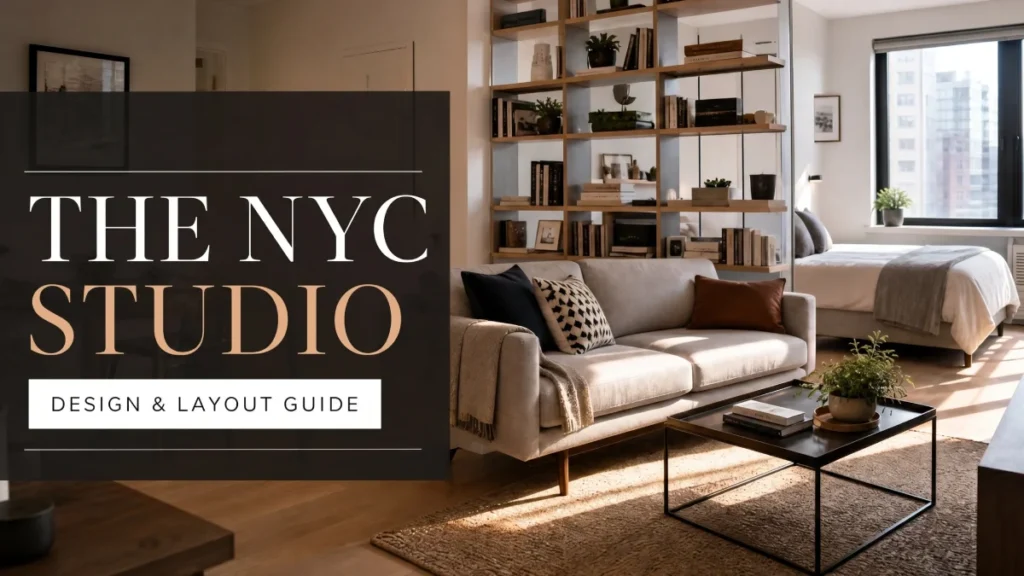
Introduction
A friend of mine moved into a 420-square-foot studio in Astoria last year. She had a queen bed, a sectional she refused to give up, and the optimism of someone who had never lived in a New York apartment before. Three weeks in, she called me. She couldn’t open the bathroom door fully without hitting her nightstand.
That’s the reality of studio living in New York. Space isn’t just limited; it’s actively working against you. The average Manhattan studio runs between 400 and 600 square feet, and in neighborhoods like the Upper West Side or Williamsburg, you’re often paying $2,500 to $3,500 a month for the privilege. You can’t afford to get the layout wrong.
Good interior design in a New York studio isn’t about making it look bigger in photos. It’s about making it function for your actual life, working from home, having a guest over, cooking a real meal without feeling like you’re in a ship galley. These ideas are built around that reality.
Understanding the NYC Studio Layout Before You Design Anything
Most New York studios fall into one of three layouts: the basic rectangle (one long room with a kitchen alcove), the alcove studio (a slightly recessed area that creates a sleeping nook), and the junior 4, which is technically a studio with a partial wall.
Each layout has a different design logic.
- Rectangle studios need strict zone separation — otherwise, the whole space feels like one cluttered room with no beginning or end
- Alcove studios give you a natural bedroom boundary, which you should use. Don’t waste it by putting a desk there
- Junior 4s have more flexibility, but often have awkward corners and older pre-war architecture that limits where you can place furniture
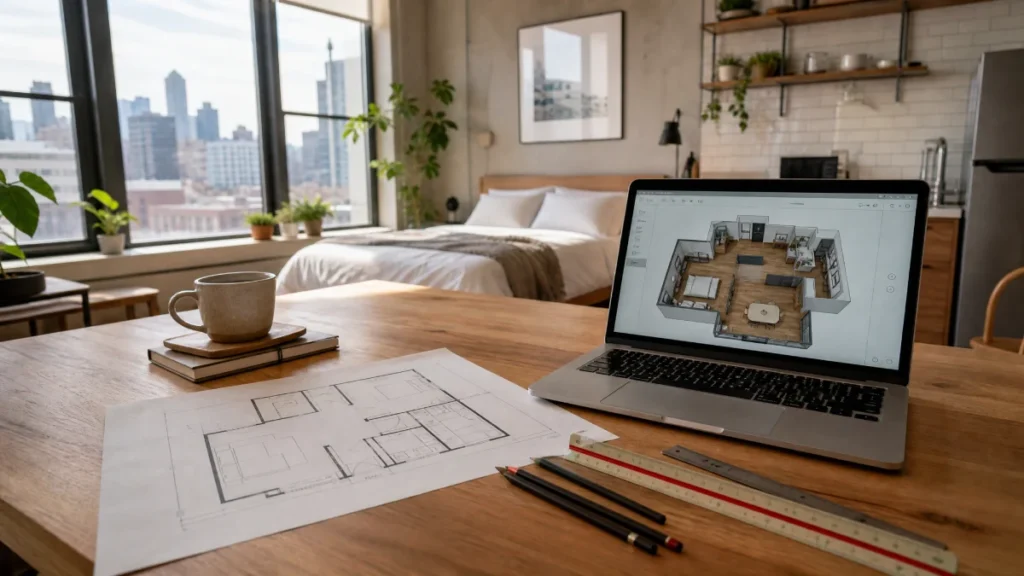
Before buying a single piece of furniture, get your floor plan. Many NYC landlords provide these. If yours doesn’t, spend $0 and use a free tool like RoomSketcher or Planner 5D to map out your actual square footage. This single step will save you from making the most common mistake NYC renters make: buying furniture for your home, only to find it doesn’t fit through the door or leaves no walkway.
The Furniture Rules That Actually Work in NYC Studios
Scale is everything. A standard 90-inch sectional that looks normal in a New Jersey suburb will consume 40% of your studio floor. The rule: no single piece of furniture should take up more than 25% of any wall, and you need at least 36 inches of clearance for walkways.
Specific furniture choices that hold up in NYC studios:
- Sofa: A 72-inch loveseat or apartment-sized sofa (look at Article, Burrow, or IKEA’s ÄPPLARYD line — prices range $400–$1,200) rather than a full-length couch
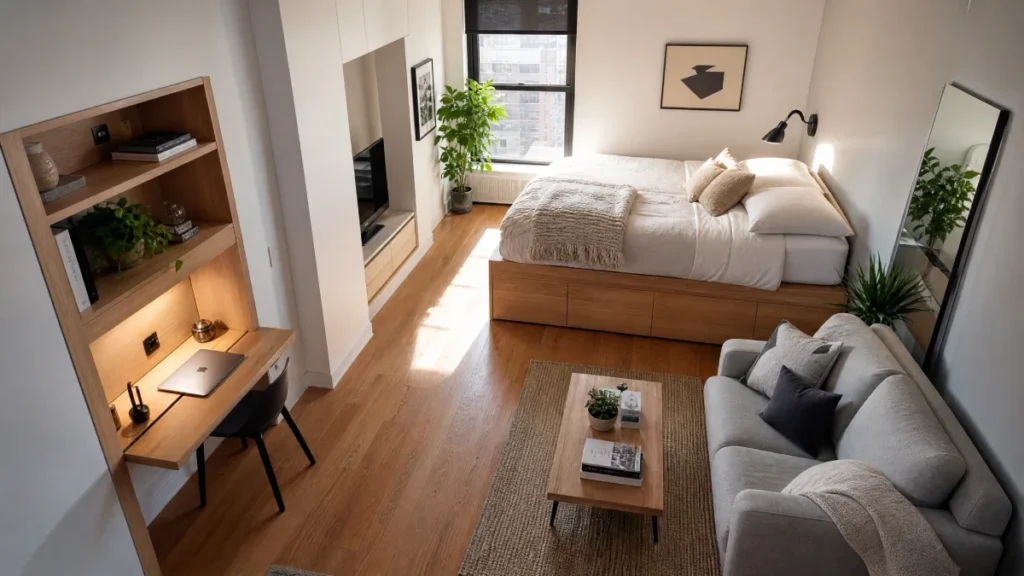
- Bed: A platform bed with built-in storage drawers underneath is worth every dollar — typically $300–$800 at stores like Bed Bath & Beyond or West Elm. This eliminates the need for a dresser entirely
- Dining: A drop-leaf table pushed against the wall works for solo living. When you have guests, it opens up. CB2 and West Elm both carry good versions in the $200–$500 range
- Desk: Wall-mounted fold-down desks are the most space-efficient option. IKEA’s NORBERG is $40 and holds up fine for laptop use
One thing to avoid: multipurpose furniture that requires too many steps to convert. Murphy beds sound ideal in theory, but if it takes you four minutes to transition from “bedroom mode” to “living room mode,” you’ll stop doing it within a month.
Zoning Without Walls: How to Divide a Studio Intelligently
The biggest visual problem in a studio apartment is that everything bleeds into everything else. Your bed is visible from your kitchen. Your desk faces your couch. Nothing feels intentional.
The fix isn’t walls — it’s visual anchors.
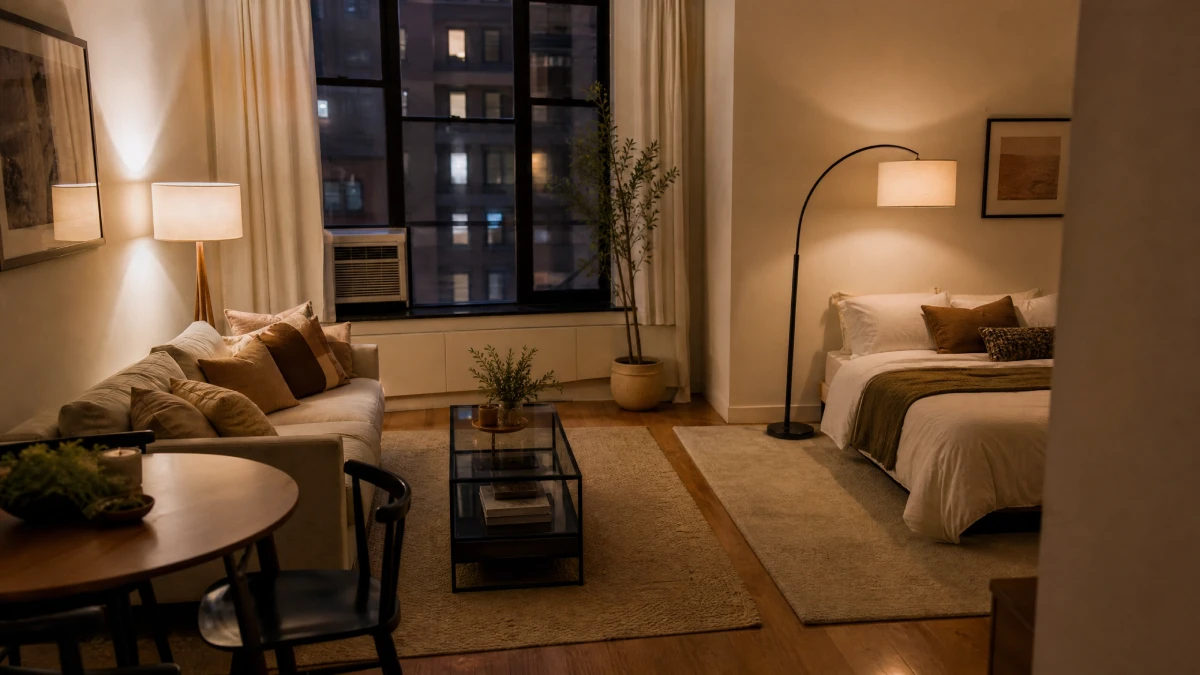
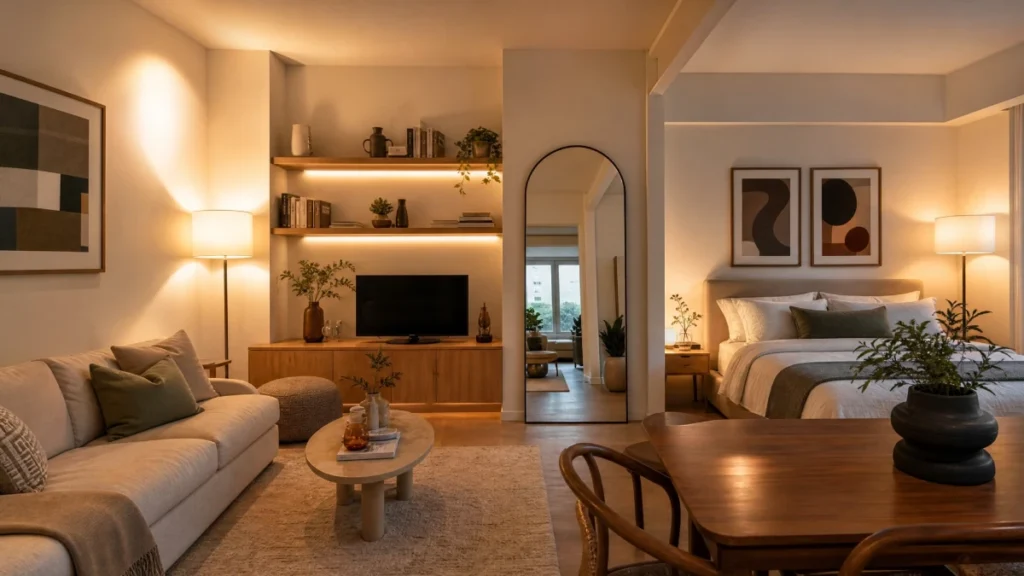
- Rugs are the most effective zoning tool available. Place a large area rug (8×10 minimum) under your living area furniture. This tells the eye, “This is the living room.” Your sleeping area gets its own smaller rug, or none at all, depending on the floor. The visual separation happens without any physical barrier.
- Bookshelves used as room dividers work particularly well in alcove studios. An open-back KALLAX unit from IKEA ($150–$250) placed perpendicular to the wall creates a soft boundary between sleeping and living zones while adding storage. It doesn’t block light, which is critical in New York apartments where natural light is already limited.
- Curtains around the bed are an underused option. Floor-to-ceiling curtain tracks (Kvartal from IKEA, around $150 installed) can enclose a sleeping area completely when closed and disappear when open. This works especially well in railroad-style apartments.
- Lighting zones reinforce everything. Overhead lighting is flat and makes a studio feel like a waiting room. Use floor lamps and table lamps to create pools of light specific to each zone. Your living area has warm ambient light. Your desk has directional task lighting. This costs $100–$300 in total and does more for the apartment’s feel than most furniture changes.
Storage: The Real Design Problem in New York Studios
In a New York studio, storage isn’t a nice-to-have — it’s structural. If you don’t solve it, everything else fails.
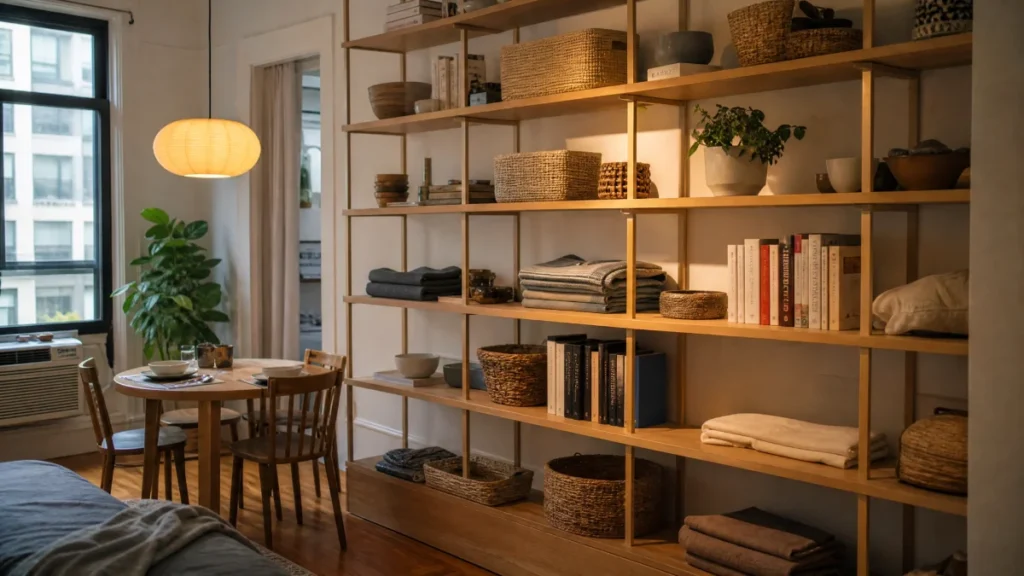
The vertical wall is your most underused asset. Most NYC apartments have 8- to 9-foot ceilings, and most renters use maybe the bottom 6 feet. Installing floor-to-ceiling shelving on one wall can add 30–50 linear feet of storage without touching the floor plan.
Practical storage hierarchy for NYC studios:
- Under the bed: Clothes you don’t wear seasonally, extra linens, shoes. Vacuum storage bags from Amazon ($20–$40 for a set) compress bulky items significantly
- Ottoman with storage: Replaces a coffee table and holds blankets, remotes, chargers — CB2 and West Elm have good options between $150–$400
- Over-door organizers: Back of bathroom door, bedroom closet door, front door — all viable. Command hooks and over-door racks cost under $30 each
- Kitchen walls: Open shelving above counters for dishes and frequently used items. In NYC apartments, cabinets are often undersized and awkwardly placed — wall shelves are a better use of vertical space
One honest note on closets: most NYC studio closets are inadequate. A standard reach-in closet with a single rod handles maybe 40% of what most people own. A basic Elfa or IKEA PAX system ($200–$500 for a single closet) with double hanging rods and shelves can effectively double your closet capacity. This is one of the highest-ROI changes you can make.
Color and Light: What Actually Makes a Small Space Feel Larger
The conventional advice is “paint everything white.” That’s partially right but incomplete.
True white on walls with no natural light (which describes a significant number of NYC studios, especially those facing north or airshafts) looks cold and institutional. A warm off-white — Benjamin Moore’s White Dove (OC-17) or Sherwin-Williams’ Alabaster (SW 7008) — reflects light without the sterile feel. Both run $60–$80 per gallon, and a studio needs one to two gallons.
What actually expands a space visually:
- Continuous flooring with no transitions. If your studio has multiple flooring types, it creates visual breaks that chop up the space. If you’re doing a renovation, continuous LVP (Luxury Vinyl Plank) throughout reads as one unified room
- Mirrors placed strategically, not randomly. A large mirror (36″ x 48″ or bigger) on the wall opposite your main window reflects light and creates depth. Don’t scatter small mirrors — it looks cluttered
- Low-profile furniture. Furniture with legs (rather than pieces that sit on the floor) creates visual breathing room and makes the space feel taller
On window treatments: keep them simple and hang them high. Curtain rods mounted 2–4 inches below the ceiling (rather than directly above the window frame) visually extend the ceiling height. This is a $20–$50 fix that has a measurable effect on how the room feels.
What NYC Studio Renovations Actually Cost
If you’re an owner (co-op or condo), you have more options but also more constraints — many NYC buildings require board approval for any work and have rules about work hours and contractor licensing.
Realistic cost tiers for NYC studio design work:
- Refresh ($500–$2,000): New paint, updated lighting fixtures, area rugs, new window treatments, storage additions. This is 100% DIY-friendly and doesn’t require any permits or approvals.
- Moderate update ($2,000–$8,000): Custom closet systems, new flooring, kitchen backsplash, bathroom vanity replacement. Some of this requires a contractor. Expect to pay NYC contractor rates, which run 30–50% higher than national averages.
- Full renovation ($15,000–$40,000+): New kitchen, bathroom gut renovation, custom built-ins, electrical updates. Requires permits, board approval in co-ops, and a licensed NYC contractor. Budget 15–20% over any quoted price for surprises in older NYC buildings.
- For renters: most of this is off the table. Focus on removable, damage-free solutions — peel-and-stick backsplash tiles, tension rod shelving systems, and furniture-based storage. Don’t make permanent changes without written landlord approval unless you’re willing to lose your security deposit.
Common Mistakes NYC Studio Owners and Renters Make
- Buying furniture before measuring. Happens constantly. Measure doorways (NYC apartment doors are often 28–30 inches, not 32–36 like most US homes) before buying anything that needs to come through them.
- Prioritizing aesthetics over function. A beautiful marble coffee table that eats all your floor space isn’t beautiful when you’re stepping over it every morning.
- Ignoring acoustics. NYC studios have noise issues — from neighbors, street traffic, and thin walls. Hard surfaces make it worse. Rugs, upholstered furniture, and curtains absorb sound. This is practical, not just decorative.
- Over-decorating. More stuff does not make a small space feel more “designed.” It makes it feel cluttered. Pick fewer things and make each one count.
- Underinvesting in lighting. Single overhead fixture + whatever natural light comes in is not a design plan. Lighting is the cheapest way to upgrade how a space feels and the most overlooked.
FAQ
How much does it cost to furnish a NYC studio apartment from scratch?
Budget $4,000–$8,000 for a functional, well-designed setup using mid-range stores like IKEA, West Elm, and Article. If you’re buying everything at once, prioritize bed, sofa, and storage first — everything else is secondary.
Is it worth hiring an interior designer for a NYC studio?
For most renters, no. The cost of a NYC interior designer ($150–$300/hour or a flat fee of $2,000–$5,000 for a studio) doesn’t pencil out unless you’re a co-op owner doing a significant renovation. Use free resources like Houzz and Pinterest for visual direction, then make your own decisions.
Can I renovate my NYC rental apartment?
Minor changes (painting, adding shelving, installing a removable backsplash) are generally fine with landlord permission. Any structural change, plumbing work, or electrical work requires a licensed contractor and building permits — and most landlords won’t allow it in rental units.
Do I need a permit to install built-in shelving in a NYC studio?
For furniture-style built-ins that don’t attach to structural walls or involve electrical/plumbing, typically no permit is required. For anything involving structural modifications, you need a permit from the NYC Department of Buildings. When in doubt, consult a licensed contractor before starting.
What’s the best furniture store for NYC apartment-sized pieces?
IKEA (Red Hook location or online delivery) for budget and functional pieces. West Elm and CB2 for mid-range quality. Article and Interior Define for sofas with apartment-friendly dimensions. Avoid big-box furniture stores that don’t offer apartment-scale sizing.
Conclusion
Designing a New York studio well isn’t about tricks or visual illusions. It’s about making honest decisions — buying furniture that fits, creating real zones for different activities, solving storage before you think about aesthetics, and investing in lighting over decoration.
The apartments that work well aren’t the ones with the most furniture or the boldest design choices. They’re the ones where the person living there thought clearly about how they actually use the space and designed around that. Do the floor plan first. Measure twice. Buy less than you think you need. That’s genuinely the most useful advice for any NYC studio — and it costs nothing to follow.
