

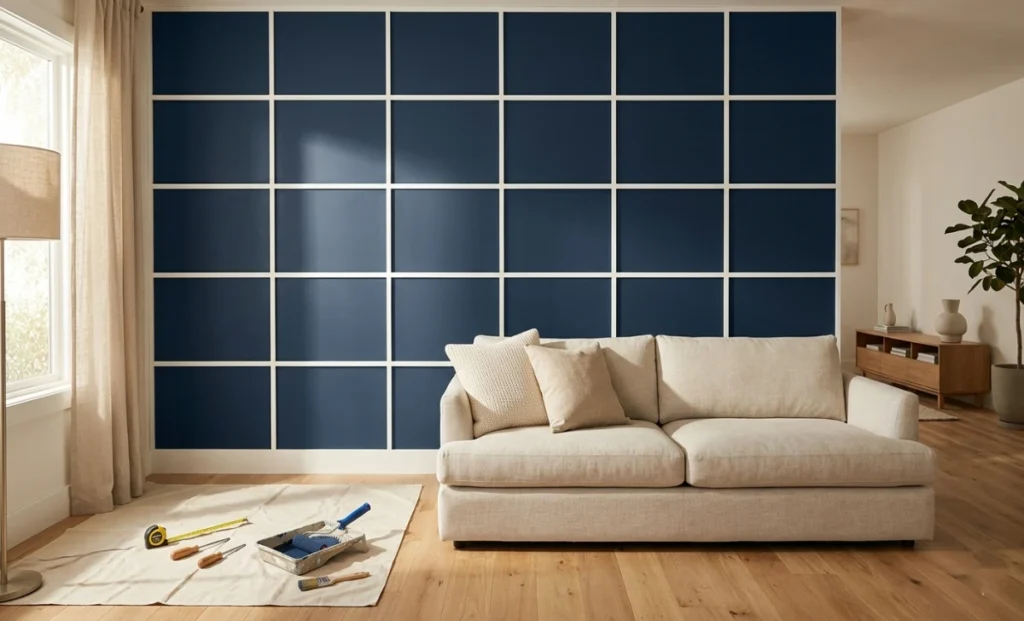
A DIY accent wall is one of the fastest ways to change how a room feels without repainting every wall or replacing furniture. You can build one using wood planks, MDF panels, peel-and-stick tiles, or even a bold paint color. Most projects cost between $50 and $300, take a weekend to finish, and need only basic tools. This guide walks you through the best ideas, the right wall to choose, and the step-by-step process to get it done.
Accent walls have been around for decades, but the approach has shifted. Homeowners in 2026 are moving away from a single painted wall and toward textured, three-dimensional designs that hold up under natural light and look good in photos. The DIY version of this trend is not just for experienced woodworkers. With the right plan, a beginner can finish a clean wood panel wall in a single weekend.
The question is not whether you should do it. The question is which approach fits your room, your budget, and your skill level.
Which Wall Should You Choose for an Accent Wall
Choosing the wrong wall is the most common mistake people make before they ever pick up a saw. Most designers recommend the wall you see first when you walk into a room. In a bedroom, that is typically the wall behind the headboard. In a living room, it is often the wall your couch faces.
A few rules worth following: the wall should not have too many windows, outlets, or switches, since working around them slows you down and complicates the installation. A flat, uninterrupted surface gives you the cleanest result. If your room has an existing focal point like a fireplace, build on that wall and let the accent treatment frame it.
Natural light also matters. A dark wood treatment on a north-facing wall with no windows can make a room feel closed in. On a south or west-facing wall with solid afternoon light, that same treatment looks warm and intentional.
DIY Accent Wall Ideas Worth Trying
Not every accent wall requires a saw or a nail gun. Here are four approaches ranked from simplest to most involved.
Paint-only accent wall. Pick one wall, use a contrasting or deeper shade of your existing color, and apply two coats. Benjamin Moore’s Hale Navy and Sherwin-Williams Tricorn Black are two colors that have remained popular because they read as bold without overwhelming small rooms. Budget: $40 to $80 for paint and supplies.
Peel-and-stick wood planks. These come pre-finished and apply directly to drywall with adhesive backing. They work in rentals since removal does not damage the wall. Budget: $80 to $150 for a standard 10×8-foot wall.
Horizontal shiplap wall. Shiplap uses thin wood boards installed in rows with small gaps between them. You can buy pre-primed MDF shiplap boards at most hardware stores for around $1 per linear foot. A nail gun speeds up the process, but construction adhesive works on lighter boards. Budget: $100 to $200.
Vertical or grid panel wall. This is the look you see most often in living rooms and home offices right now. You frame out a grid of rectangles using thin MDF strips (called lattice or parting stop molding), then paint the whole wall and the grid the same color. The result is a high-end paneling effect that costs a fraction of real wainscoting. Budget: $150 to $300.
What You Need Before You Start
For most wood-based DIY accent walls, you need the same core set of tools and materials. You do not need all of them for every project, but having them before you start prevents mid-project trips to the hardware store.
Tools: miter saw or circular saw, brad nailer or finish nailer with an air compressor, tape measure, level, stud finder, drill, and caulk gun.
Materials: your chosen boards or panels, construction adhesive, finishing nails, sandable, paintable caulk, primer, and paint.
One prep step most tutorials skip: clean and lightly sand the wall before you start. Drywall accumulates dust and oils over time, and adhesive bonds poorly to a dirty surface. Wipe it down with a damp cloth, let it dry fully, then start your layout.
How to Build a Wood Panel Accent Wall Step by Step
This process covers the grid panel wall, which is currently the most searched DIY accent wall style.
Start by painting the wall and the MDF strips the same color before installation. It is far easier to paint flat pieces on a workbench than to cut in around installed molding. Use a satin or semi-gloss finish so the wall is easier to clean.
Measure your wall and plan your grid on paper first. A standard approach is to divide the wall into equal rectangles, keeping the outermost frame about six to eight inches from the ceiling, floor, and sides. Mark the stud locations with a stud finder and lightly pencil the grid layout directly on the wall.
Cut your MDF strips to length using a miter saw. For the cleanest corners, cut the horizontal pieces to the full width of each rectangle and butt the vertical pieces between them, rather than mitering the corners at 45 degrees. Mitered corners look sharp but require precision that most beginners do not have yet.
Apply construction adhesive to the back of each strip in a zigzag pattern, press it against your pencil marks, and fire two or three finishing nails through it into the drywall. If a nail lands near a stud, sink it into the stud for a stronger hold.
Once all strips are installed, run a thin bead of paintable caulk along every seam where the strip meets the wall. Smooth it with a wet finger. This step fills any gaps and makes the joint look like it was always part of the wall. Touch up with paint, and the wall is done.
Common Mistakes That Ruin Accent Walls
Skipping the level check is the fastest way to ruin a grid panel wall. Even a half-degree drift compounds across a long wall. Check the level every three to four strips, not just at the start.
Using the wrong adhesive is another mistake. Standard white craft glue does not hold MDF to drywall. Use a construction adhesive rated for wood-to-drywall applications, such as Loctite PL Premium or Liquid Nails Heavy Duty.
Painting after installation instead of before adds hours of cutting-in work and usually produces a messier result. Paint your pieces first.
Finally, do not skip caulk. The gap between an MDF strip and an uneven wall is obvious in raking light. Caulk fills it and gives the wall a built-in look rather than an applied-on-top look.
How Much Does a DIY Accent Wall Cost
A basic peel-and-stick or paint-only accent wall costs $40 to $100. A shiplap wall on a 10×8-foot surface runs $100 to $200. A full grid panel wall with MDF, primer, paint, caulk, and adhesive typically lands between $150 and $300.
For comparison, hiring a contractor to install wainscoting or board-and-batten on a similar wall starts at $800 and often exceeds $1,500 depending on your location. The DIY version produces a comparable visual result for a fraction of that cost, provided you follow the prep and installation steps carefully.
FAQs
Can you do a DIY accent wall in a rental apartment?
Yes. Peel-and-stick wood planks and removable wallpaper panels are both designed for temporary installation. They apply with an adhesive that releases cleanly from most painted drywall. Always test a small patch before covering the full wall.
What is the easiest DIY accent wall for a beginner?
A paint-only accent wall is the most accessible starting point. You need no cutting tools, no special materials, and you can complete it in a few hours. If you want texture, peel-and-stick planks are the next step up without requiring a saw.
How long does a DIY accent wall take to finish?
A paint-only wall takes two to four hours, including dry time. A shiplap or grid panel wall typically takes one full day for installation and a second day for caulking and touch-up paint.
Do I need to find studs for a wood accent wall?
For lighter peel-and-stick or thin plank installations, construction adhesive alone holds well. For heavier MDF panels or boards thicker than 3/4 inch, nailing into studs adds long-term security and prevents sagging over time.
What color should I paint an accent wall?
Choose a color two to three shades darker or more saturated than the rest of the room. If your walls are a warm off-white, a deep olive, navy, or charcoal gives a strong contrast without looking jarring. Avoid colors that share no tonal relationship with your existing furniture.
