

For over five decades, Jack Nicholson has called a single address home — a hillside estate on Mulholland Drive in Beverly Hills that has quietly evolved into one of Hollywood’s most remarkable private residences. With three Academy Awards, twelve Oscar nominations, and a career that redefined American cinema, Nicholson poured the same deliberate craft into shaping his home as he did into his most celebrated roles. Jack Nicholson’s house is not a showpiece built for magazine covers. It is a lived-in reflection of a man who values art, comfort, privacy, and the slow accumulation of a life well-examined.
This article explores the design philosophy behind Jack Nicholson’s Beverly Hills estate — from its museum-calibre art collection to its warm, unpretentious interiors — and draws out the principles any homeowner can apply. We also trace how a single bold career decision funded an entire real estate empire, and revisit the midcentury bachelor pad where Nicholson’s design story first took shape.
Jack Nicholson’s Beverly Hills Estate
Jack Nicholson’s house sits at 12850 Mulholland Drive, Beverly Hills — an address that places him in one of the most storied stretches of residential real estate in Los Angeles. The main residence, built in 1957, spans approximately 3,303 square feet on a plot that originally measured just over half an acre. Nicholson purchased the property in 1969, reportedly for around $5 million, at the peak of his early career momentum following Easy Rider.
Over the following decades, he steadily acquired neighbouring properties, expanding the estate into a private compound that now stretches across roughly three acres. In 2005, that expansion took on cinematic significance when Nicholson purchased the adjacent home that had belonged to Marlon Brando and had it rebuilt. The acquisition made thematic sense: the Mulholland Drive enclave where both men settled has long been nicknamed “Bad Boy Drive” for the concentration of Hollywood’s most magnetic and unconventional leading men living side by side — including Warren Beatty. Nicholson himself refers to the address simply as “Bad Boy Hill.”
Architecturally, the estate blends traditional and contemporary sensibilities. Its exterior features elegant lines and expansive windows that draw in natural light while maintaining the privacy Nicholson has always valued. Hillside positioning provides sweeping views of the canyon and the Los Angeles skyline beyond. At an estimated current value of approximately $10 million, the property’s worth lies less in square footage and more in its half-century of continuous, intentional refinement by one of cinema’s greatest collectors and aesthetes.
The Luxurious Interior Design
Stepping inside Jack Nicholson’s house, the first thing that registers is not opulence but atmosphere. The foyer introduces a tone of understated warmth: rich, dark wood contrasts with light, airy wall colours, and a grand staircase draws the eye upward. But it is the art — hanging on virtually every wall, occupying every sightline — that tells you who lives here.
A $150 Million Art Collection as Interior Architecture
Nicholson’s art collection has been valued at an estimated $150 million, making it one of the most significant private collections held by an individual outside the traditional gallery world. This is not decoration. It is the defining element of the home’s interior identity.
The collection spans eras and movements. Works by Pablo Picasso, Henri Matisse, and Auguste Rodin share wall space with pieces by Fernando Botero, René Magritte, and Tamara de Lempicka. The breadth reflects a sensibility that resists easy categorization. As Nicholson himself put it: “I like a lot of kinds of painters. You can’t name a painter that I don’t like.”
Among the most documented relationships in his collection is with artist Ed Ruscha, with whom Nicholson owns between six and eight works, including WOLF and Sin, as well as several paintings of birds. In 1995, Ruscha assessed the collection publicly, calling it “one of the best collections out here” — a remark that speaks to the seriousness with which the art world regards Nicholson’s eye.
The Andy Warhol connection adds another layer. Nicholson and Warhol were photographed together at Quo Vadis restaurant in New York City in October 1976, and Warhol subsequently conducted an interview with Nicholson for the December 1976 cover of Interview magazine. The conversation began over lunch — joined by Bob Colacello and Marina Schiano — and continued at Nicholson’s suite at the Carlyle Hotel. That friendship translated into multiple Warhol works now displayed in the Beverly Hills home.
Less widely known is Nicholson’s early eye for emerging talent. In 1996, a Jack Vettriano exhibition in Hong Kong titled Halfway to Paradise caught his attention, and Nicholson purchased three works on the spot, including Dancer for Money and Night Geometry. The purchase illustrates a collecting philosophy that extends beyond blue-chip names — Nicholson acquires what moves him, regardless of an artist’s market standing at the time.
Lighting, Texture, and the Art of Comfort
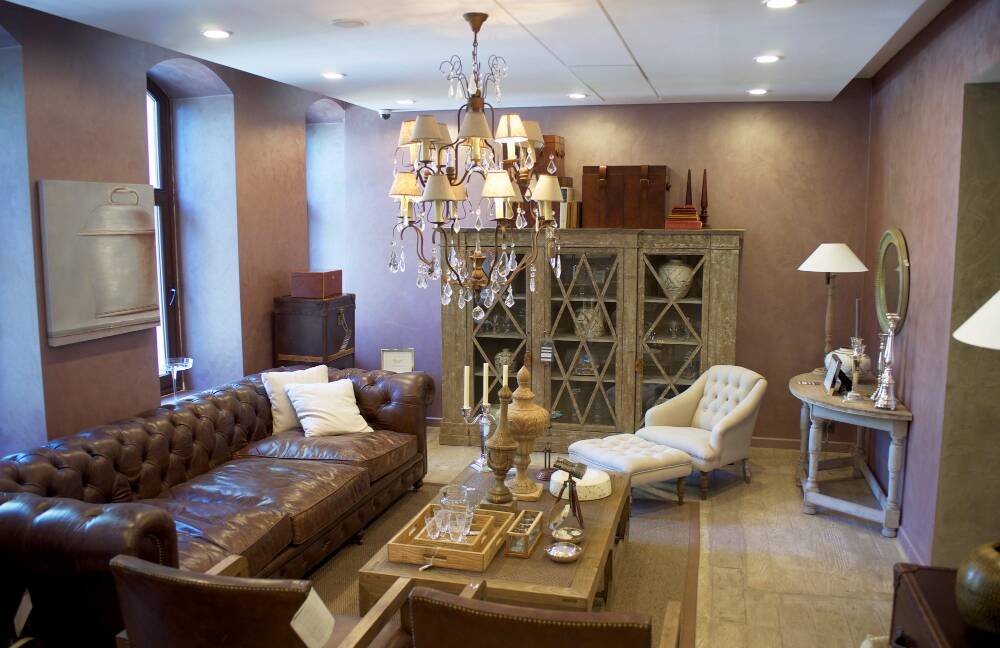
Beyond the art, the interiors are shaped by deliberate choices in lighting and material. An antique chandelier hangs above the entryway, casting a warm, diffused glow that avoids the harshness of overhead fixtures. Throughout the home, light sources are layered — table lamps, wall sconces, and candles grouped on trays — to create intimate pools of warmth rather than uniform brightness.
Furnishings lean toward the tactile and the lived-in. A worn leather couch anchors the living room, its patina earned over years of genuine use rather than distressed for effect. Plush cushions in neutral tones — sand, slate blue, warm grey — invite lingering. Throw blankets add texture without clutter. The overall impression is of a home designed not to impress visitors but to make them stay.
Lessons in Interior Design
Jack Nicholson’s house demonstrates a principle that many renovated homes miss: beauty and function are not competing goals. Every room in the estate serves a clear purpose while contributing to the home’s visual coherence.
The Kitchen: Where Craft Meets Utility
The kitchen strikes a careful balance between a working space and a gathering place. Custom cabinetry — crafted from quality wood with glass-panelled doors — displays prized dishware while keeping it protected. Marble countertops provide a generous workspace without appearing sterile. The lighting is bright but diffused, suited to meal preparation without creating the clinical feel of a commercial kitchen.
Traditional elements ground the space: an exposed brick backsplash above the stove adds texture and history. Modern stainless steel appliances update the room for contemporary use without clashing with the older architectural bones. A central island doubles as both a preparation surface and a casual dining spot, embodying the principle that the best kitchens serve multiple roles simultaneously.
The Dining Room: Intimacy Over Formality
The dining room continues the theme of stylish informality. A round table surrounded by upholstered Parsons chairs creates an intimate setting that encourages conversation rather than stiff ceremony. Overhead, an iron-and-glass chandelier elevates the aesthetic while remaining understated enough to let the food and company take precedence.
For homeowners looking to replicate this approach, the key takeaway is proportional: choose furniture that pairs classic structural forms with soft, touchable fabrics. Select fixtures that provide adequate light without sacrificing warmth. Prioritize pieces that age gracefully — materials like natural wood, linen, leather, and stone develop character over time in ways that synthetic alternatives cannot.
Incorporating Personal History into Design
What distinguishes Jack Nicholson’s Beverly Hills estate from a professionally staged luxury home is its role as a living archive. The house is filled with personal artifacts that transform rooms from decorated spaces into narrative ones.
Framed photographs span the decades: Nicholson on film sets, at awards ceremonies, alongside colleagues and close friends. These are not curated for maximum visual impact — they are the images that matter to him. Their placement throughout the home means that memory and daily life coexist naturally, rather than being confined to an album on a shelf.
The art collection itself functions as personal history. Each acquisition marks a moment — a trip, a friendship, a creative revelation. The Warhol pieces recall a real relationship, not just an aesthetic preference. The Vettrianos represent an impulsive act of recognition in a Hong Kong gallery. Displayed together, they form a visual autobiography that no interior designer could fabricate.
Nicholson’s family life is woven into the estate as well. He is father to six children — Jennifer, Caleb, Honey, Lorraine, Ray, and Tessa — and the home reflects those relationships through photographs, personal spaces, and quiet dedications that visitors may not notice but that anchor the house in family rather than celebrity.
The broader lesson is straightforward: the most compelling interiors are not assembled from catalogues. They are built over time from objects that carry meaning. A home that displays nothing personal may photograph well, but it rarely feels like anywhere worth returning to.
Inspiration for Renovation
For those planning a renovation, Jack Nicholson’s house offers a counterintuitive lesson: the most enduring design choices are often the most restrained. Rather than chasing trends, Nicholson’s estate favours classic materials and timeless proportions — decisions that have kept the home feeling relevant across five decades of changing tastes.
Timelessness Over Trend
Choosing furnishings and finishes that mesh classic structures with contemporary comfort ensures a home transcends seasonal design cycles. Nicholson’s leather chairs, marble surfaces, and dark wood accents would have looked appropriate in 1975 and will look appropriate in 2035. The principle is simple: invest in quality materials that age well, and reserve trend-driven choices for easily replaceable elements like cushions, throws, and small accessories.
Indoor-Outdoor California Living
The estate makes full use of its Southern California setting. Expansive windows and sliding doors connect interior rooms to sunlit patios and the swimming pool beyond. Outdoor lounge areas extend the living space into the landscape, allowing residents to take advantage of the canyon views and the region’s temperate climate. This indoor-outdoor fluidity remains a defining characteristic of West Coast residential design, and Nicholson’s home demonstrates how seamlessly it can be executed when the architecture is planned around the site’s natural advantages.
Subtle Lighting as a Design Foundation
One of the most transferable lessons from the estate is its lighting strategy. Rather than relying on a single overhead source, Nicholson layers ambient, task, and accent lighting throughout each room. Table lamps provide reading light. Sconces wash walls with a soft glow. Candles grouped on trays add warmth to evening gatherings. The result is a home that feels welcoming at any hour — a quality that depends far more on lighting than on furniture or colour scheme.
Rare Look Inside Jack Nicholson’s ’60s Home
Long before the Beverly Hills compound took shape, Jack Nicholson lived in a very different kind of home. In 1969, shortly after the success of Easy Rider began to shift his career trajectory, LIFE magazine visited his bachelor pad in the Hollywood Hills for a feature that captures the actor at a pivotal moment.
The photographs show a then-thirty-something Nicholson poolside with his girlfriend at the time, in a setting that LIFE described as a “Spanish-type house.” The home was modest by Hollywood standards — clean-lined architecture with a breezy indoor-outdoor layout that reflected midcentury modern sensibilities. A brightly hued geometric rug lay across the floor. Worn Levi’s and a relaxed posture conveyed the laidback California spirit that would become inseparable from Nicholson’s public image.
The house even had a name carved into it, suggesting an early appreciation for the idea that a home should carry personal meaning — a theme that would only deepen in the decades ahead.
What is striking, looking back, is the continuity. The Hollywood Hills bachelor pad and the Beverly Hills estate that followed share a common DNA: an emphasis on natural light, a connection to the outdoors, comfortable furnishings chosen for how they feel rather than how they look in photographs, and an atmosphere that prioritizes living over performing. The scale changed dramatically. The underlying sensibility did not.
Additional Inspirations
The design language of Jack Nicholson’s house draws from several overlapping traditions — classic cinema, midcentury architecture, and the distinctive character of Los Angeles itself.
Old Hollywood Influence
Several rooms in the estate echo the dramatic interiors of Golden Age film sets. Deep blue walls adorned with intricate crown moulding lend a regal quality to the private lounge, recalling the sophistication of old cinema palaces. Ornate tilework and iron accents in the bathrooms mirror the exotic richness of classic movie set design. These choices connect the home to the broader tradition of Hollywood glamour without lapsing into pastiche.
Midcentury Modern Foundations
The estate’s bones are unmistakably midcentury: clean lines, generous glazing, and a spatial flow that blurs the boundary between inside and outside. Built-in shelving, glass walls, and open transitions between rooms reflect the modernist ideals that shaped the hillside homes of postwar Los Angeles. The terraces and verandas overlooking the canyons embrace the quintessential Southern California lifestyle that midcentury architects championed — and that remains the region’s most enduring residential design contribution.
The “Something’s Gotta Give” Connection
No discussion of Jack Nicholson and interior design is complete without acknowledging the cultural impact of the 2003 film Something’s Gotta Give. Directed by Nancy Meyers, the film featured a Hamptons beach house that became a design phenomenon in its own right — its white marble kitchen, slipcovered linen sofas, and coastal textures sparking a wave of imitations that persists over two decades later.
While the movie house and the Beverly Hills estate are entirely separate properties, they share a sensibility: the belief that elegance need not be formal, that luxury is most powerful when it feels effortless, and that the best-designed rooms are the ones people never want to leave. Meyers later noted that the house was designed to feel like a real home rather than a set — an aspiration that mirrors how Nicholson has approached his own residence.
The Real Estate Empire Behind the Estate
The story of Jack Nicholson’s house is inseparable from the financial foundation that made it possible — and that foundation has one extraordinary origin point.
When Warner Bros. approached Nicholson to play the Joker in Tim Burton’s 1989 Batman, the actor made a decision that would reshape his financial life. Rather than accepting his standard $10 million upfront fee, he agreed to a reduced payment of $6 million in exchange for a percentage of the film’s box office gross, merchandise revenue, and earnings from any future sequels. It was a gamble on a comic book property at a time when superhero films were far from guaranteed hits.
Batman earned $411 million worldwide and became a merchandising juggernaut — toys, clothing, collectibles, and Joker-branded products generated hundreds of millions in licensing revenue. According to Nicholson’s biographer Marc Eliot, the actor’s total earnings from the film approached $90 million, making him the highest-paid actor for a single movie at the time and producing one of the most lucrative deals in Hollywood history.
That windbank funded a real estate portfolio now valued at over $100 million. Beyond the Beverly Hills compound, Nicholson’s holdings have included:
- A 70-acre ranch in Malibu with panoramic ocean views
- A 28-acre Malibu estate — featuring a tennis court, putting green, grotto-style spa, and swimming pool — which he sold in 2011 for $3.5 million
- Newberry House in Aspen, co-owned with producer and close friend Lou Adler — purchased in 1980 for $550,000 and sold in 2013 for $11 million
- Additional properties in Santa Monica and Venice
- A beachfront home in Kailua, Hawaii
With an estimated net worth of approximately $400 million, Nicholson’s real estate acquisitions represent not just wealth but a philosophy: the belief that property, like art, rewards patience and long-term vision. Each home served a different purpose — the Malibu ranch for solitude, the Aspen house for winter retreats with friends, the Hawaiian property for oceanfront escape — but all reflected the same instinct toward spaces that feel personal rather than performative.
Conclusion
Jack Nicholson turned 89 on April 22, 2026, and by all accounts, his Beverly Hills estate remains the centre of a quiet, largely private life. He was spotted at the SNL 50th Anniversary celebration in early 2025, wearing an Armani suit and a Yankees beret, greeted warmly by the audience. His close friend Danny DeVito has visited recently and describes him as doing well. Director James L. Brooks insists Nicholson is still reading scripts. His daughter Lorraine shared a rare birthday photograph that offered fans a brief glimpse of the man behind the legend.
For most of his days, though, Nicholson stays close to home — a choice his longtime friend Lou Adler explained simply on the WTF with Marc Maron podcast. When someone offered Nicholson a film role, he declined, saying, “You know what I did today? I sat under a tree, and I read a book.”
That contentment — the willingness to find richness in stillness — runs through every room of the estate. Jack Nicholson’s house is not a monument to fame. It is the physical expression of a life lived with curiosity, taste, and an uncommon understanding of what makes a space worth inhabiting. For homeowners and design enthusiasts, its lessons are as applicable to a city apartment as they are to a hillside compound: invest in what you love, let your home tell your story, prioritize comfort alongside beauty, and trust that the best design decisions are the ones you never feel the need to update.
