

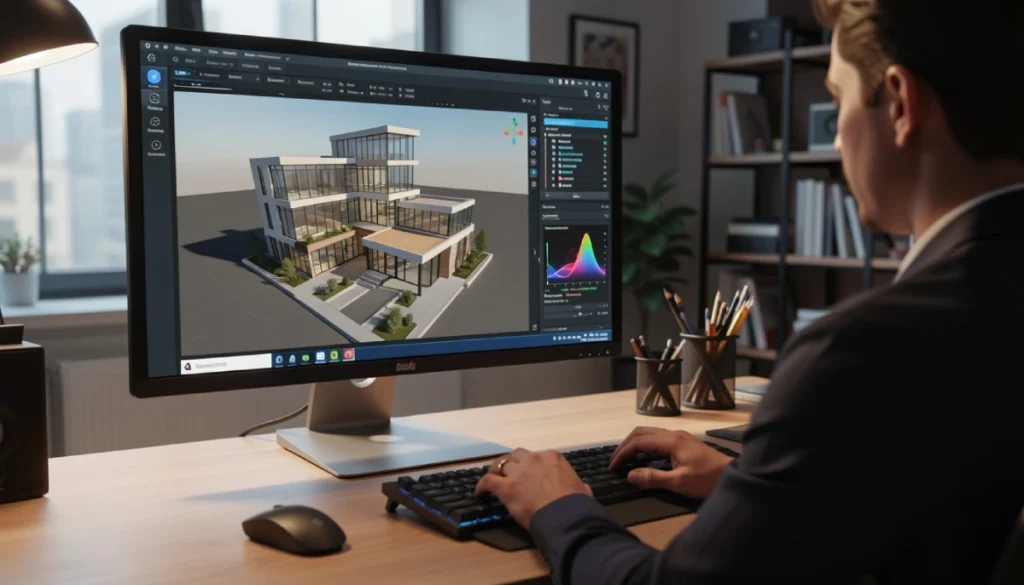
AI isn’t just tweaking 3D rendering—it’s completely reshaping how creators build, visualize, and ship photoreal experiences. Render times are dropping, detail is sharpening, and realism now rivals live-action footage—all thanks to AI learning from millions of reference frames. By leveraging AI in 3D rendering, businesses and creators now produce incredible visuals with unprecedented focus and control.
AI rendering engines enhance workflows by learning from vast datasets to deliver more effective, higher-quality results. Techniques like Neural Radiance Fields (NeRF) now reconstruct complex lighting and geometry from sparse input data, enabling photorealistic renders of intricate environments, lifelike shadows, and dynamic textures—all generated with intelligent assistance.
As we move through 2026, AI-3D rendering integration is accelerating—workflow automation, real-time feedback loops, and generative asset creation are now standard in professional pipelines. This technology is setting a new industry standard, from automated scene choreography to pixel-level detail refinement.
Key Benefits of AI-Driven 3D Rendering
So what’s actually changing for creators? Three shifts stand out: accuracy that adapts, speed that scales, and customization that just works.
Much Better Accuracy and Realism
AI-powered rendering engines like Unreal Engine 5’s Lumen or Blender’s AI denoiser now auto-calculate global illumination and material responses, delivering cinema-grade realism without manual light-baking—cutting iteration time from hours to minutes. Realistic textures, accurate lighting, and natural movements are now generated intelligently, making any design look production-ready.
Resources (and Time!) Efficiency
Traditional rendering is notoriously time-consuming and processor-intensive. But with AI-driven rendering, platforms like NVIDIA Omniverse leverage AI to sync rendering tasks across distributed teams, cutting project handoff time by automating asset optimization and version control. The result? Projects finish faster with smarter resource allocation.
Advanced Customization
AI 3D modeling is evolving with unprecedented flexibility—empowering designers to fine-tune everything from material properties to environmental lighting, achieving unique outcomes that align perfectly with project requirements.
AI Innovations Expected in 2026
What’s defining 2026 rendering trends? With AI revolutionizing how we present designs, this year delivers major leaps in AI 3D rendering capabilities:
- Smarter Rendering Tools. New AI-based tools emphasize predictive analytics and automated design adjustments—anticipating changes before you even make them.
- Real-Time Rendering. New approaches like Gaussian Splatting enable real-time rendering of complex scenes at 60+ FPS on consumer hardware—making iterative design feedback instantaneous and cutting revision cycles dramatically.
- Broader Applications. AI is expanding into new domains, unlocking novel applications across spatial computing, gaming, and augmented reality.
With these innovations, 3D rendering in 2026 is more responsive, efficient, and empowering for creators than ever before.
AI-Driven Rendering in Different Industries
AI-driven rendering is transforming industries across the board—and the impact is measurable.
Architecture
In architecture, firms using AI rendering tools like Enscape AI or Twinmotion cut client approval cycles by 40% by generating photorealistic walkthroughs from BIM data in minutes—not days. These renders automatically account for surrounding context, lighting conditions, and material behaviors.
Real Estate
For real estate, AI-powered 3D renderings help developers market properties with immersive, photoreal visuals—driving faster sales by attracting qualified buyers who can truly envision the space.
Product Design
In product design, AI 3D modeling accelerates prototyping by generating accurate, detailed visuals of concepts early in the process—reducing time-to-market and enabling faster iteration on physical products.
Conclusion
AI-driven rendering isn’t a future promise—it’s delivering measurable gains in quality, speed, and creative freedom right now, with 2026 marking a tipping point. The impact is visible across sectors, transforming how businesses and audiences connect through visual experiences.
Ready to ship visuals that convert? See how Genense’s AI-rendering pipeline helps teams like yours cut production time while boosting client engagement.
Explore our 2026 case studies → https://www.genense.com.
