


Kitchen remodel cost in Texas typically ranges from $12,000 for a budget refresh to over $75,000 for a luxury renovation, with most homeowners spending between $25,000 and $45,000 for a mid-range project. The final number depends heavily on cabinet quality, countertop material, and whether you’re moving plumbing or electrical.
In most Texas homes I’ve worked on, labor costs run lower than in coastal states, which stretches renovation budgets further. That said, no state income tax means many Texas homeowners have more discretionary cash for upgrades, which pushes demand for mid-to-high-end finishes in cities like Austin and Dallas.
This guide breaks down real costs by budget tier, what drives price differences, and how to decide where your money is best spent.
Understanding Kitchen Remodel Costs for Texas Homeowners
Kitchen remodeling costs in Texas are shaped by three regional factors: a competitive contractor market, larger average lot and home sizes, and a construction culture built around single-family houses rather than dense urban housing. Because Texas homes tend to have bigger kitchen footprints than homes in the Northeast, material costs can run higher even when labor rates are lower.
A common issue I see in Texas remodels is homeowners underestimating square footage costs. A 200-square-foot kitchen in a Houston suburb will cost meaningfully more in materials than a 120-square-foot kitchen, even with identical finishes, simply because there’s more cabinetry and countertop to cover.
Labor rates in Texas metros like Austin, Dallas-Fort Worth, and San Antonio are generally 10–20% lower than in California or New York for comparable work. This gap narrows in Austin due to high demand from tech-sector homeowners, but it still holds statewide.
Budget vs Luxury: What Actually Changes
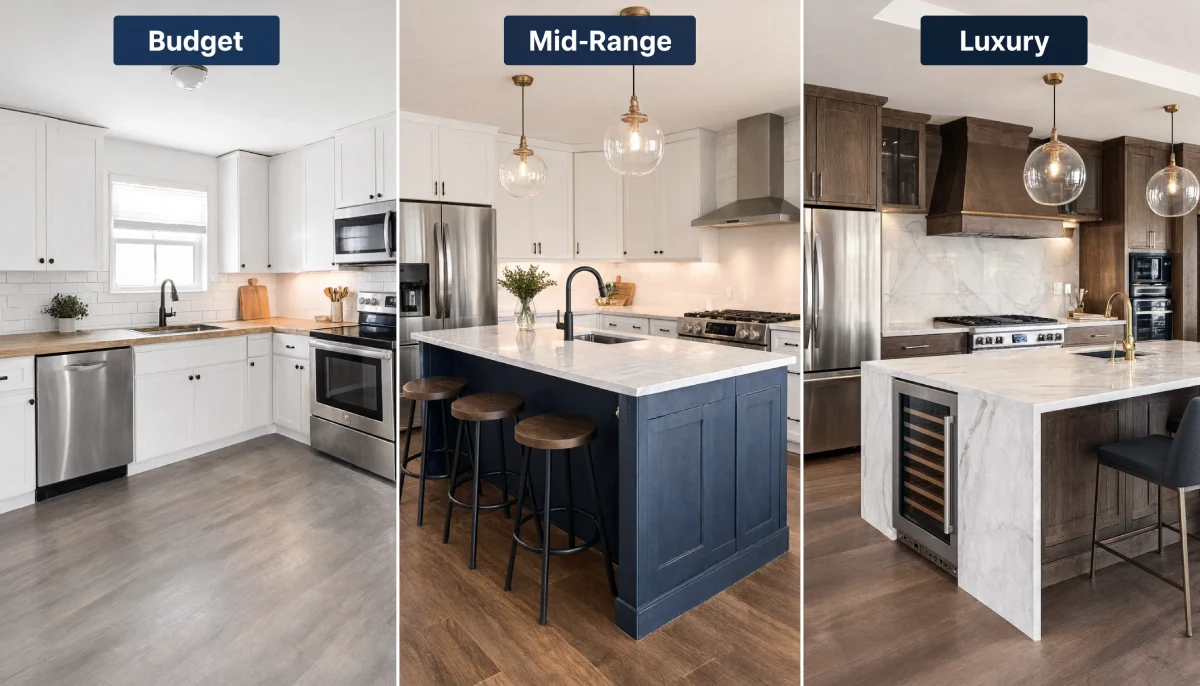
The difference between a budget and a luxury kitchen remodel isn’t just about spending more. It changes which materials, layouts, and timelines are realistic.
- Budget kitchen renovation ($12,000–$25,000): Keeps the existing layout, refaces or paints cabinets instead of replacing them, uses laminate or budget quartz countertops, and reuses existing appliances where possible.
- Mid-range remodel ($25,000–$45,000): New stock or semi-custom cabinets, granite or mid-tier quartz countertops, new appliances, and updated lighting and flooring.
- Luxury remodel ($45,000–$75,000+): Full custom cabinetry, premium stone countertops like quartzite or marble, layout changes involving plumbing or electrical moves, high-end appliance packages, and often an island expansion or wall removal.
A mistake I see often in Texas remodels: homeowners assume a bigger budget automatically means better resale value. In many Texas suburbs, a mid-range remodel with clean, neutral finishes returns more value at resale than an ultra-luxury kitchen that doesn’t match the rest of the home.
Cost Breakdown by Budget Tier
| Item | Budget Tier | Mid-Range Tier | Luxury Tier |
|---|---|---|---|
| Cabinets | $3,000–$6,000 (refacing) | $8,000–$15,000 (semi-custom) | $20,000–$40,000 (full custom) |
| Countertops | $1,500–$3,000 (laminate) | $3,500–$6,500 (granite/quartz) | $7,000–$15,000 (quartzite/marble) |
| Appliances | Reuse existing | $3,000–$6,000 (mid-tier package) | $8,000–$20,000 (premium package) |
| Flooring | $1,200–$2,500 (vinyl/tile) | $2,500–$5,000 (tile/hardwood) | $5,000–$10,000 (natural stone/wide-plank hardwood) |
| Labor & Installation | $4,000–$7,000 | $7,000–$12,000 | $12,000–$25,000 |
| Plumbing/Electrical Changes | Minimal | $1,500–$4,000 | $4,000–$10,000+ |
| Total Estimated Range | $12,000–$25,000 | $25,000–$45,000 | $45,000–$75,000+ |
Texas-specific cost notes: Larger kitchen footprints common in Texas suburban homes can push material costs 10–15% above national averages, even when labor stays competitive. Homeowners in Austin and Dallas should expect labor quotes on the higher end of these ranges due to contractor demand; San Antonio and smaller metros often run lower.
Comparing Countertop Options
| Material | Initial Cost | Long-Term Cost | Durability | Maintenance | Installation Difficulty | Best Use Case |
|---|---|---|---|---|---|---|
| Laminate | Low | Low | Moderate | Low | Easy | Budget remodels, rental properties |
| Granite | Mid | Low | High | Moderate (sealing) | Moderate | Mid-range remodels want a natural stone look |
| Quartz | Mid-High | Low | High | Low | Moderate | Homeowners wanting durability without sealing upkeep |
| Quartzite/Marble | High | Moderate | High (marble stains) | High | Difficult | Luxury remodels, resale-focused high-end homes |
In Texas heat and humidity, quartz tends to outperform granite for homeowners who don’t want to keep up with resealing schedules, especially in homes without central humidity control in the kitchen area.
Pros and Cons of Each Budget Tier
Budget Renovation
- Pros: Lower upfront cost, faster turnaround, less disruption to daily life
- Cons: Limited layout changes, shorter lifespan on some materials, may need updates again in 8–10 years
Mid-Range Renovation
- Pros: Strong balance of cost and resale value, more material choices, moderate customization
- Cons: Still limited on major layout changes without added cost
Luxury Renovation
- Pros: Full customization, premium materials, can increase home value in high-end neighborhoods
- Cons: Longest timeline, highest risk of budget overrun, may not fully return investment in more modest neighborhoods
A common mistake I’ve seen Texas homeowners make is choosing luxury finishes in a starter-home neighborhood where comparable home sales don’t support that investment. Matching your remodel tier to your neighborhood’s price point matters more than most homeowners expect.
DIY vs Professional Help
Texas homeowners with renovation experience can reasonably DIY cabinet painting, hardware updates, backsplash tile installation, and minor lighting swaps. These tasks typically save $1,500–$4,000 in labor.
Plumbing relocation, electrical panel work, and load-bearing wall removal should go to a licensed contractor. Texas doesn’t require a statewide general contractor license, but many cities and counties have their own permit and inspection requirements, and unpermitted electrical or plumbing work can create problems during a home sale.
In my experience, the homeowners who save the most doing partial DIY are the ones who handle demolition and finish work themselves while hiring licensed professionals for plumbing, electrical, and structural changes.
Common Mistakes Homeowners Make
- Skipping permits for electrical or plumbing changes can delay or complicate a future home sale
- Underestimating the cost of moving a sink or gas line, even a few feet
- Choosing trendy finishes that may look dated within 5–7 years
- Not budgeting a 10–15% contingency for unexpected issues like outdated wiring behind cabinets
- Hiring the lowest bidder without checking references or licensing
Permits and Code Considerations in Texas
Permit requirements vary by city and county in Texas since there’s no unified statewide building code enforcement at the residential level. Cosmetic changes like painting cabinets or swapping countertops typically don’t require permits. Electrical panel upgrades, gas line moves, and plumbing relocation almost always do, and skipping this step can create issues during a future appraisal or sale inspection. Always confirm requirements with your specific city’s building department before starting structural or utility work.
Practical Tips for Your Texas Kitchen Remodel
- Get at least three itemized quotes before selecting a contractor, and confirm each one is licensed for the specific work involved
- Shop appliance packages at Home Depot or Lowe’s during major sales events like Presidents’ Day or Labor Day for meaningful savings
- Choose quartz over granite if you want to avoid a resealing schedule in Texas’s humid summer months
- Budget an extra 10–15% beyond your target for unexpected issues, especially in homes built before 1990
- Ask your contractor about lead times on custom cabinets, which can run 8–12 weeks in busy Texas metros
- If your home is in a suburb with HOA rules, confirm exterior-visible changes like window placement don’t require HOA approval
- Consider timing your remodel outside peak summer months, when contractor schedules in Texas tend to book up fastest
FAQS
How much does a kitchen remodel cost in Texas?
A kitchen remodel in Texas typically costs $12,000 to $75,000, with most homeowners spending $25,000–$45,000 for a mid-range project. Costs depend on kitchen size, cabinet quality, countertop material, and whether plumbing or electrical work is involved.
Can I DIY a kitchen remodel in my house?
Yes, for cosmetic work like painting cabinets, installing backsplash tile, or updating hardware and lighting fixtures. Structural, plumbing, and electrical work should go to a licensed professional, both for safety and to avoid complications with permits and future home sales.
Do I need a permit for a kitchen remodel in Texas?
Permit requirements depend on your city, but plumbing relocation, electrical panel work, and structural changes almost always require one. Cosmetic updates like painting or countertop replacement typically don’t. Check with your local building department before starting.
Is a kitchen remodel worth it for homeowners planning to sell?
Mid-range kitchen remodels typically return 60–80% of their cost at resale in Texas, often more in competitive suburban markets. Matching your remodel’s finish level to your neighborhood’s price range matters more for ROI than choosing the most expensive materials available.
What’s the difference between a budget and a luxury kitchen remodel?
Budget remodels reface or paint existing cabinets and use laminate or entry-level quartz, while luxury remodels involve full custom cabinetry, premium stone countertops, and layout changes. The price gap comes from material quality, customization level, and whether plumbing or electrical work is included.
How long does a kitchen remodel take in Texas?
A budget refresh can take 1–2 weeks. Mid-range remodels typically run 4–6 weeks. Luxury remodels involving custom cabinetry and layout changes often take 8–12 weeks, partly due to custom cabinet lead times common across Texas metros.
Should I replace or reface my cabinets?
Refacing works well if your existing cabinet boxes are structurally sound and you want to change color or door style at a lower cost. Full replacement makes sense if you’re changing the layout, need more storage, or the existing boxes show water damage or warping.
What appliances should I prioritize in a mid-range remodel?
Prioritize the range and refrigerator first, since these see the most daily use and have the widest price range based on features. Dishwashers and microwaves have less price variation, so they’re a lower priority for splurging within a fixed budget.
Is it worth moving my kitchen sink or stove during a remodel?
Moving plumbing or gas lines adds $1,500–$4,000 or more, depending on distance and whether walls or flooring need to be opened up. It’s worth it if the new layout significantly improves workflow, but it’s one of the first places homeowners can cut costs if the budget is tight.
Related Factors Homeowners Should Consider
Your kitchen remodel doesn’t happen in isolation from the rest of your home. Flooring that connects to adjacent living spaces, lighting that matches your home’s overall style, and even your home’s HVAC capacity, if you’re adding heat-generating appliances, all factor into a successful project. Homeowners planning to sell within 3–5 years should weigh neighborhood comps carefully before committing to luxury-tier finishes.
Conclusion
Choosing between a budget, mid-range, or luxury kitchen remodel in Texas comes down to three decisions: how long you plan to stay in the home, what your neighborhood supports at resale, and how much disruption you’re willing to take on. Budget remodels make sense for homeowners planning a shorter stay or a quick refresh. Mid-range remodels offer the strongest balance of cost and resale value for most Texas homeowners. Luxury remodels make sense in higher-end neighborhoods where comparable home sales support that investment. Get multiple contractor quotes, confirm permit requirements with your city, and budget a contingency for the unexpected. The right choice depends on your specific home, neighborhood, and timeline, not on maximizing spend.
